How to Set Price Alerts in 5 Minutes
Set up effective price alerts in under 5 minutes. Learn the exact alert strategy professional traders use to never miss opportunities.
Most traders either set no alerts and miss opportunities, or set too many alerts and get overwhelmed by noise. They alert random price levels without a clear plan, then ignore the alerts when they trigger.
Professional traders use a systematic alert strategy that captures every important move without creating alert fatigue. This guide shows you exactly how to set up an effective alert system in under 5 minutes.
Alert Placement Strategy
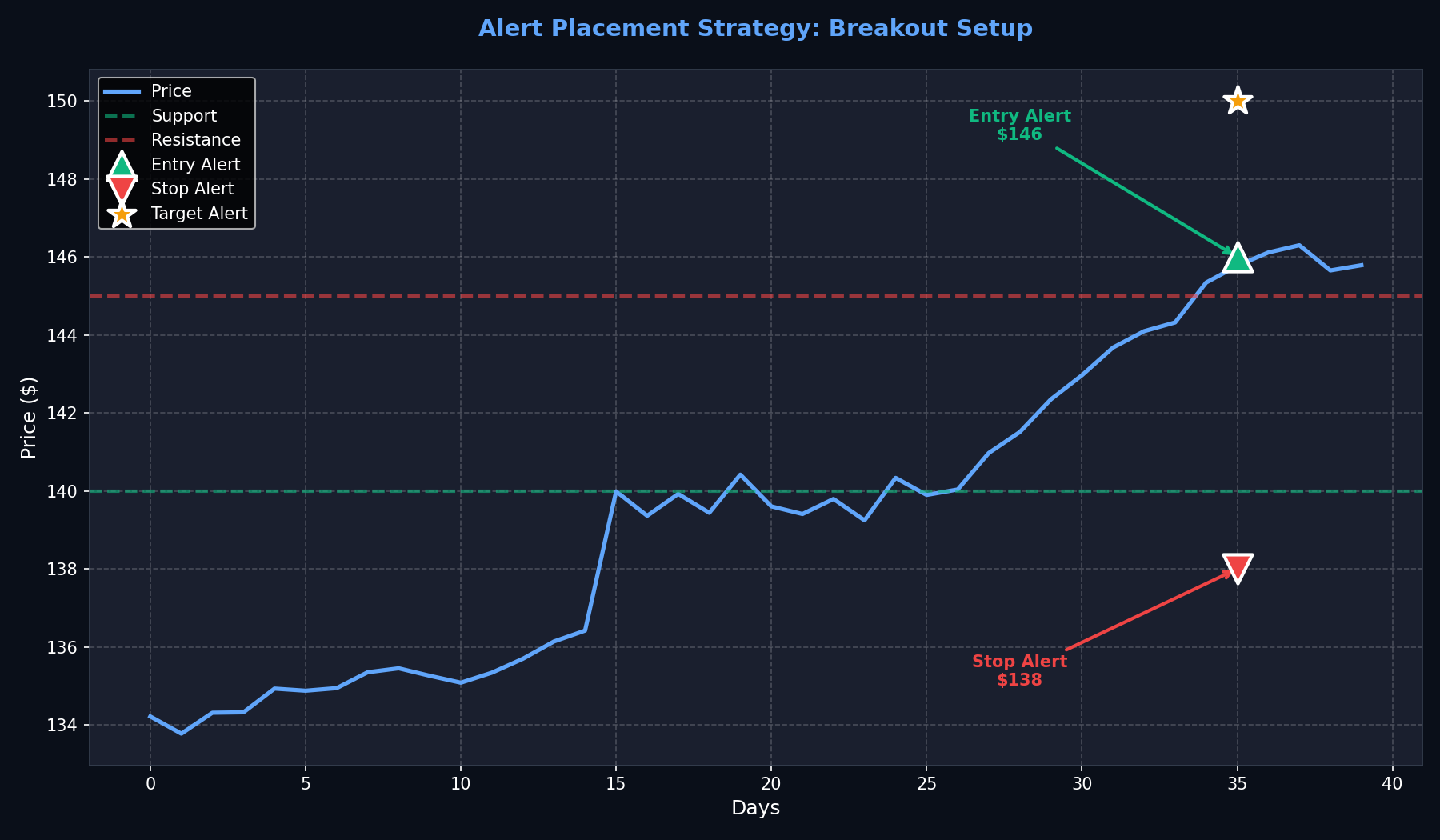
Chart showing optimal alert placement for breakout, pullback, and reversal setups
3-Alert Rule Visualization
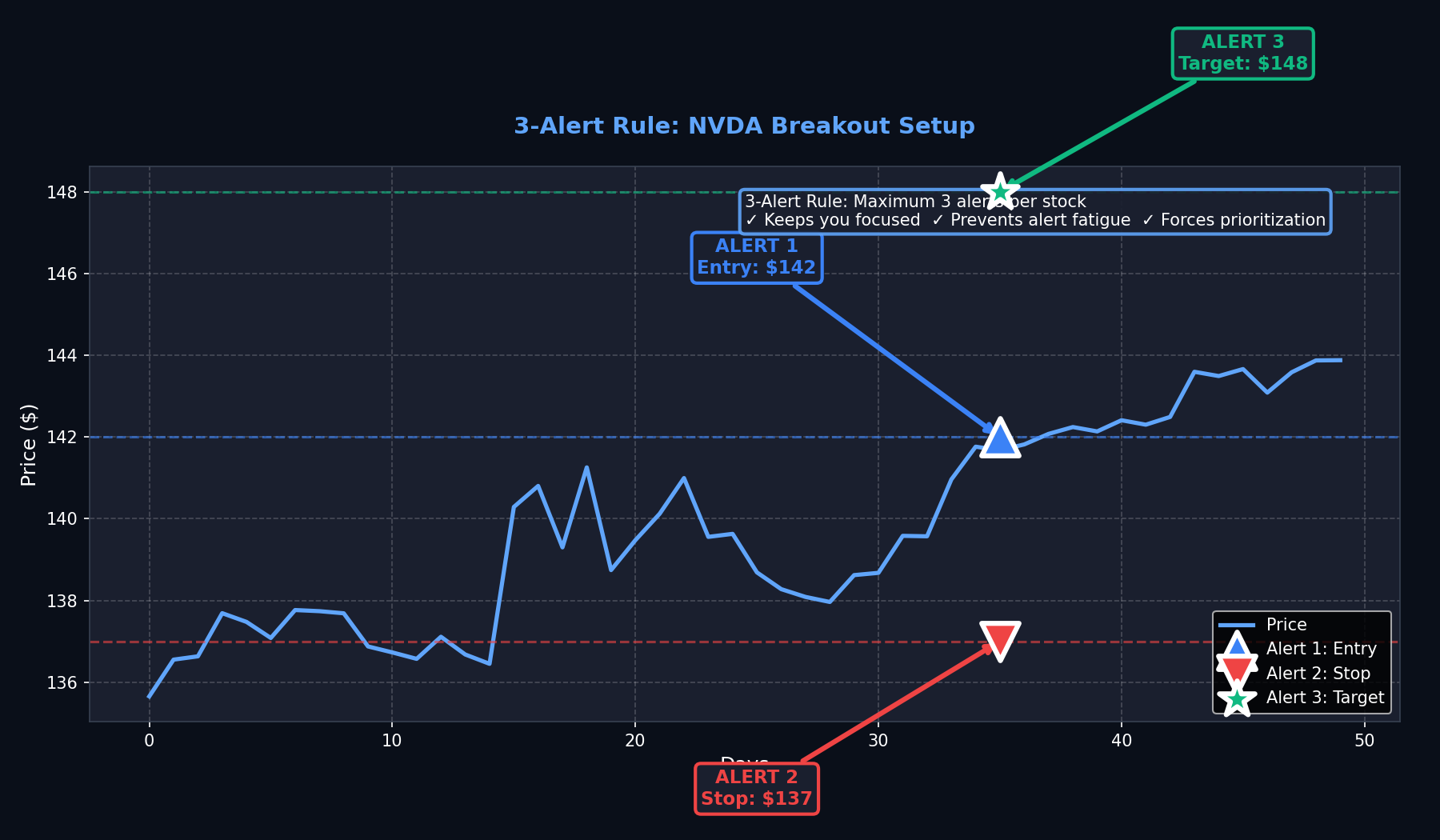
Example of the 3-alert system on an active trade
Why Most Alert Systems Fail
The problem isn't the alert tool - it's the strategy. Here's what goes wrong:
Too many alerts: Setting alerts at every support and resistance level creates noise. You get 20+ alerts per day and start ignoring them. The goal is quality alerts, not quantity.
No action plan: An alert without a plan is useless. When the alert triggers, you should know exactly what to do - enter, exit, or reassess. No thinking required.
Wrong price levels: Alerting at exact support/resistance often triggers too early or too late. You need to alert at actionable levels where you'll actually make a decision.
Alert fatigue: When you get too many alerts, you start ignoring them all. Then you miss the one alert that actually mattered. Less is more.
The 5-Minute Alert Framework
Here's how to set up a complete alert system in under 5 minutes:
Minute 1: Identify Alert-Worthy Stocks
Only set alerts for stocks that meet these criteria:
- ✓ On your active watchlist (Tier 1 or 2)
- ✓ Have a clear setup developing
- ✓ At or near a key decision point
- ✓ You would actually trade if triggered
If a stock doesn't meet all 4 criteria, don't set an alert. You're just creating noise.
Minute 2: Set Entry Alerts
For each stock, set ONE entry alert at the trigger level:
- Breakouts: Alert 1-2% above resistance
- Pullbacks: Alert at support level
- Reversals: Alert at reversal confirmation level
Don't set multiple entry alerts. Pick the ONE level that matters most.
Minute 3: Set Stop Alerts
For positions you own, set stop alerts:
- Alert 2-3% above your actual stop (early warning)
- Alert at your exact stop level (exit signal)
- Alert at breakeven (for trailing stops)
These protect you from catastrophic losses if you're not watching.
Minute 4: Set Target Alerts
For open positions, set profit target alerts:
- Alert at 50% of target (consider taking partial profits)
- Alert at full target (exit or trail stop)
- Alert at extended target (if momentum continues)
These ensure you don't miss profit-taking opportunities.
Minute 5: Label and Organize
Add clear labels to each alert:
- "NVDA - Entry $140 breakout"
- "AVGO - Stop $180 (2% warning)"
- "PLTR - Target $75 (50%)"
When the alert triggers, you'll know exactly what it means without checking the chart.
The 3-Alert Rule
For each stock, set a maximum of 3 alerts. This forces you to prioritize and prevents alert fatigue.
| Position Status | Alert 1 | Alert 2 | Alert 3 |
|---|---|---|---|
| Watching (No Position) | Entry trigger | Invalidation level | - |
| In Position | Stop loss | First target | Final target |
| Partial Position | Trailing stop | Next target | Extended target |
Alert Placement by Setup Type
Different setups require different alert strategies:
Breakout Alerts
Set alerts at these levels:
- Entry: 1-2% above resistance (confirms breakout)
- Invalidation: Back below resistance (failed breakout)
- Target: Measured move from base
Example: NVDA consolidating at $138. Set entry alert at $140, invalidation at $137, target at $148.
Pullback Alerts
Set alerts at these levels:
- Entry: At support level (50MA, prior resistance)
- Invalidation: 3-5% below support (trend broken)
- Target: Prior high or next resistance
Example: AVGO pulling back to $180 support. Set entry at $180, invalidation at $175, target at $195.
Reversal Alerts
Set alerts at these levels:
- Entry: Above reversal candle high (confirmation)
- Invalidation: Below reversal candle low (failed reversal)
- Target: 50% retracement of decline
Example: Stock reverses at $50 with hammer candle. Set entry at $52, invalidation at $48, target at $58.
Advanced Alert Strategies
Time-based alerts: Set alerts to trigger only during market hours. This prevents after-hours noise that you can't act on anyway.
Volume-confirmed alerts: Some platforms let you set alerts that only trigger if volume exceeds a threshold. This filters out low-volume fake moves.
Multi-timeframe alerts: Set one alert on the daily chart (main signal) and one on the 4-hour chart (early warning). When both trigger, the setup is stronger.
Relative strength alerts: Alert when a stock's RS vs SPY crosses above/below key levels. This catches momentum shifts early.
Alert Management Rules
Rule #1: Delete triggered alerts immediately
Once an alert triggers and you take action (or decide not to), delete it. Don't let old alerts clutter your system.
Rule #2: Review alerts weekly
Every Sunday, review all active alerts. Delete alerts for stocks that no longer have valid setups. Update alert levels if the setup has changed.
Rule #3: Maximum 15 active alerts
If you have more than 15 alerts, you're tracking too many stocks. Prioritize ruthlessly. Quality over quantity.
Rule #4: Test your alerts
Set a test alert at the current price to verify your alert system is working. Nothing worse than missing a trade because your alerts weren't set up correctly.
Common Alert Mistakes
Mistake #1: Alerting at exact support/resistance
Price rarely hits exact levels. Alert 1-2% beyond key levels to confirm the move is real, not just a test.
Mistake #2: Setting alerts and forgetting
Alerts are not a substitute for monitoring. Check your watchlist daily even if no alerts trigger. Setups can develop between alert levels.
Mistake #3: No action plan
When an alert triggers, you should know exactly what to do. If you have to "check the chart and decide," your alert strategy needs work.
Mistake #4: Ignoring alert fatigue
If you're getting 10+ alerts per day and ignoring most of them, you have too many alerts. Cut your list in half.
Best Alert Tools
TradingView
Best for: Custom technical alerts
Pros: Unlimited alerts (paid), indicator-based alerts, mobile notifications
Cons: Free version limited to 1 alert
Worth the $15/month for serious traders.
Thinkorswim
Best for: Complex conditional alerts
Pros: Unlimited alerts, advanced conditions, free with TD Ameritrade
Cons: Steeper learning curve
Best for traders who want sophisticated alert logic.
MarketDly
Best for: Pre-configured setup alerts
Pros: Alerts for AI-analyzed setups, no configuration needed
Cons: Focused on swing trading only
Skip the alert setup - get notified when pre-analyzed setups trigger.
Real Example: My Alert Setup
Here's my actual alert configuration as of January 30, 2026:
Watching (No Position) - 5 alerts
- NVDA: Entry $140, Invalidation $137
- AVGO: Entry $185, Invalidation $180
- PLTR: Entry $72, Invalidation $69
- AMD: Entry $145, Invalidation $140
- AMAT: Entry $195, Invalidation $188
In Position - 6 alerts
- MSFT: Stop $405, Target $425, Extended $435
- GOOGL: Stop $168, Target $180, Extended $185
Total: 11 alerts. All have clear action plans. No noise.
Alert Response Checklist
When an alert triggers, follow this 30-second checklist:
- 1. Check the chart (10 seconds): Is the move confirmed with volume?
- 2. Check the market (5 seconds): Is SPY supporting the move?
- 3. Execute or pass (10 seconds): If both check out, execute. If not, delete alert and move on.
- 4. Update alerts (5 seconds): If you entered, set stop and target alerts. If you passed, delete the alert.
The Bottom Line
Effective price alerts aren't about setting alerts at every level - they're about setting the RIGHT alerts at actionable levels with clear plans. The 5-minute framework forces you to be selective and systematic.
Most traders fail because they either set no alerts and miss opportunities, or set too many alerts and get overwhelmed. The solution is a focused alert system with maximum 15 alerts, clear action plans, and regular maintenance.
Start with the 3-alert rule per stock. Track which alerts lead to profitable trades. Within a few weeks, you'll have an alert system that captures every important move without creating noise.
Continue Learning
Ready to Put This Into Practice?
Join MarketDly to access real-time market insights, AI-powered analysis, and professional trading tools.
No credit card required • Free tier available • Upgrade anytime