How to Plan a Trade in 5 Minutes
Create a complete trade plan in under 5 minutes. Learn the exact pre-trade checklist professional traders use before every entry.
Most traders enter positions without a plan. They see a setup, get excited, and click buy. Then they spend the entire trade second-guessing themselves: "Should I exit now? Is this still working? What was my target again?"
Professional traders never enter a trade without a complete plan. They know their entry, stop, targets, and exit conditions before they risk a single dollar. This guide shows you how to create a bulletproof trade plan in under 5 minutes.
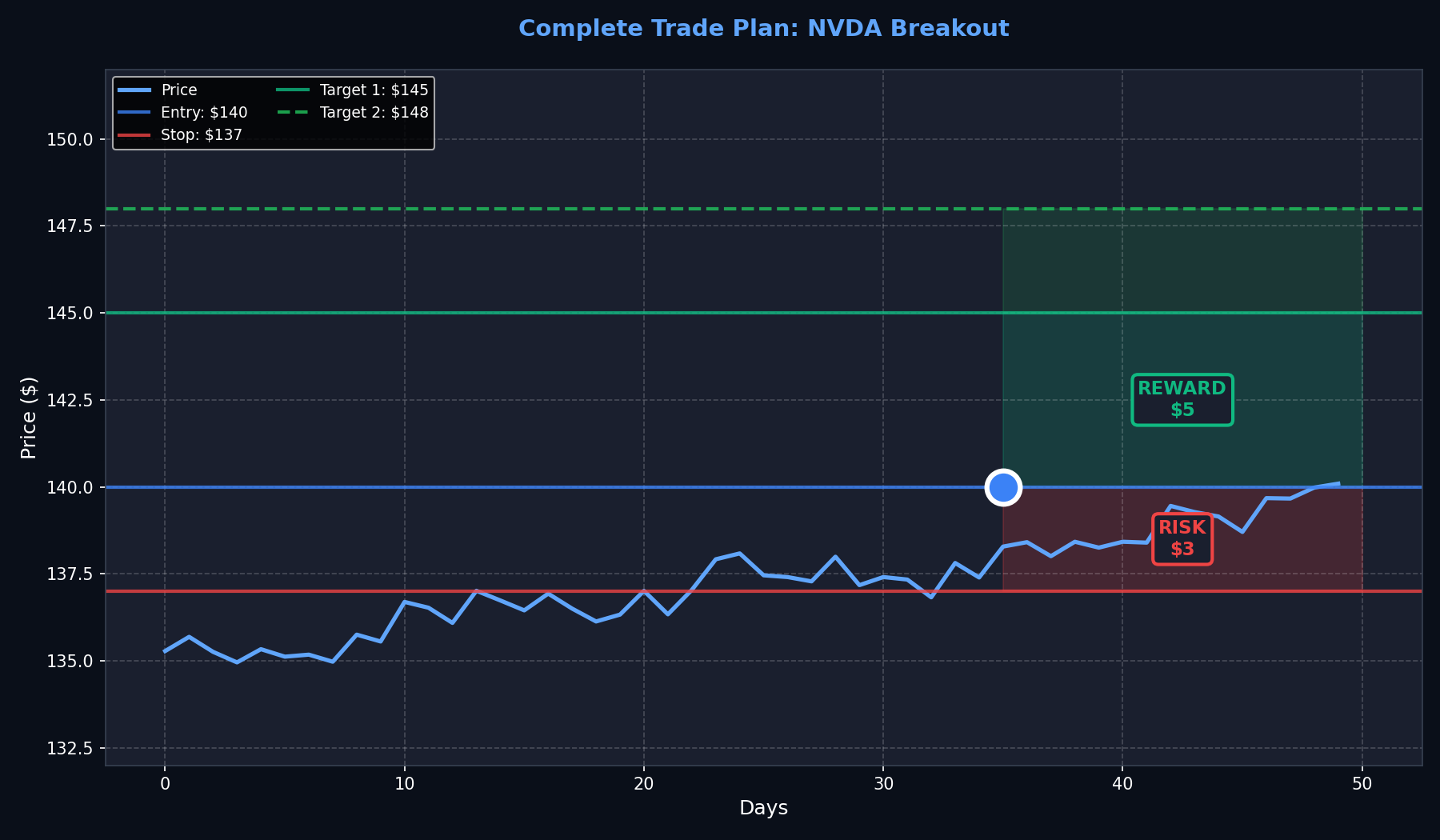
Complete Trade Plan Example
NVDA chart with entry, stop, targets, and risk/reward calculations annotated
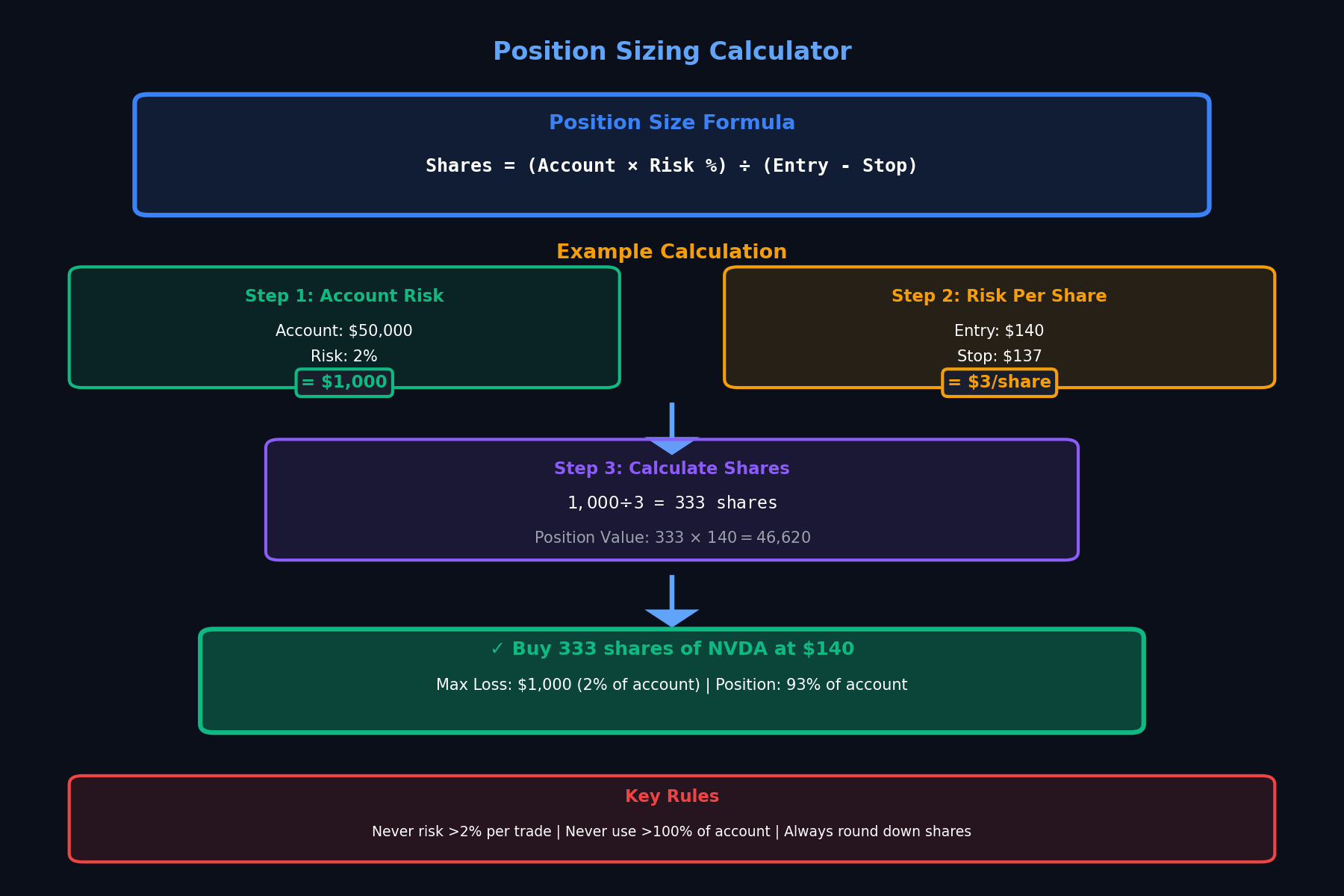
Position Sizing Calculator
Visual guide to calculating position size based on account risk
Why Trading Without a Plan Fails
Trading without a plan is gambling. Here's what goes wrong:
Emotional decisions: Without a plan, every price move triggers an emotional response. You exit winners too early and hold losers too long. A plan removes emotion from the equation.
No risk management: If you don't know your stop before entry, you'll either risk too much or exit too early. Both kill profitability.
Inconsistent results: Random entries lead to random results. You can't improve what you can't measure. A plan creates consistency.
Analysis paralysis: Without a plan, you'll spend the entire trade analyzing and second-guessing. A plan lets you execute and move on.
The 5-Minute Trade Planning Framework
Here's how to create a complete trade plan in under 5 minutes:
Minute 1: Define the Setup
Write down in one sentence why you're taking this trade:
- "NVDA breaking out of 3-week consolidation with volume"
- "AVGO pulling back to 50MA in strong uptrend"
- "PLTR reversing at major support with hammer candle"
If you can't explain the setup in one sentence, you don't understand it well enough to trade it.
Minute 2: Calculate Entry and Stop
Determine exact price levels:
- Entry: Where will you enter? (specific price, not "around $140")
- Stop: Where are you wrong? (below support, below recent low)
- Risk per share: Entry - Stop = $ risk
Example: Entry $140, Stop $137, Risk = $3/share
Minute 3: Set Targets and Calculate R:R
Identify profit targets:
- Target 1: First resistance or measured move (take 50% off)
- Target 2: Extended target (let rest run)
- R:R ratio: (Target - Entry) / (Entry - Stop)
Example: T1 $145 (5:1 R:R), T2 $150 (10:1 R:R). Minimum 2:1 required.
Minute 4: Calculate Position Size
Determine how many shares to buy:
- Account risk: 1-2% of account per trade
- Dollar risk: Account size × Risk % = $ to risk
- Position size: $ to risk ÷ Risk per share = Shares
Example: $50K account, 2% risk = $1,000. Risk $3/share = 333 shares.
Minute 5: Define Exit Conditions
Write down when you'll exit (besides hitting stop/target):
- Time stop: Exit if no progress in X days
- Invalidation: Exit if setup breaks (loses key level)
- Market stop: Exit if SPY breaks key support
These prevent you from holding dead positions hoping they'll "come back."
The Complete Trade Plan Template
Use this template for every trade. Fill it out before entry:
Trade Plan Template
Ticker: _______
Date: _______
Setup: ________________________________
Entry: $______
Stop: $______ (Risk: $____/share)
Target 1: $______ (R:R: ___:1) - Exit 50%
Target 2: $______ (R:R: ___:1) - Exit 50%
Position Size: _____ shares ($_____ total)
Account Risk: ____% ($______)
Exit Conditions:
- - Time: Exit if no progress in ___ days
- - Invalidation: Exit if _______________
- - Market: Exit if SPY breaks $_____
Trade Planning by Setup Type
Different setups require slightly different planning approaches:
| Setup Type | Entry Trigger | Stop Placement | Target Method |
|---|---|---|---|
| Breakout | 1-2% above resistance | Below breakout level | Measured move from base |
| Pullback | At support level | Below support | Prior high |
| Reversal | Above reversal candle | Below reversal low | 50% retracement |
| Momentum | On strength | Below recent low | ATR-based |
Real Example: Complete Trade Plan
Here's a real trade plan I created on January 29, 2026:
NVDA Breakout Trade Plan
Ticker: NVDA
Date: January 29, 2026
Setup: Breaking out of 3-week consolidation after strong uptrend. Volume declining during consolidation (healthy). RS vs SPY positive.
Entry: $140.00 (breakout above consolidation)
Stop: $137.00 (below consolidation low) - Risk: $3.00/share
Target 1: $145.00 (R:R 5:3 = 1.67:1) - Exit 50%
Target 2: $148.00 (R:R 8:3 = 2.67:1) - Exit 50%, trail stop
Position Size: 333 shares ($46,620 total)
Account Risk: 2% ($1,000)
Exit Conditions:
- - Time: Exit if no progress in 5 days
- - Invalidation: Exit if closes back below $138
- - Market: Exit if SPY breaks $580 support
Result: Entered $140.20, exited 50% at $145.50, rest at $147.80. +$2,400 profit.
Position Sizing Rules
Position sizing is the most important part of your trade plan. Get this wrong and nothing else matters.
The 2% Rule
Never risk more than 2% of your account on a single trade:
- $10K account = $200 max risk per trade
- $50K account = $1,000 max risk per trade
- $100K account = $2,000 max risk per trade
This ensures you can survive 10+ consecutive losses without blowing up.
Position Size Formula
Calculate shares to buy:
Shares = (Account × Risk %) ÷ (Entry - Stop)
Example:
Shares = ($50,000 × 2%) ÷ ($140 - $137)
Shares = $1,000 ÷ $3 = 333 shares
Common Planning Mistakes
Mistake #1: Planning after entry
If you're figuring out your stop after you've entered, you're gambling. Plan BEFORE you risk money.
Mistake #2: Moving stops
Your stop is where you're wrong. If price hits it, you were wrong. Moving stops to "give it more room" is how accounts blow up.
Mistake #3: No profit targets
"I'll just see how it goes" is not a plan. Define targets before entry. You can always adjust if the setup extends, but you need a baseline.
Mistake #4: Ignoring market context
Your trade plan should include market conditions. If SPY is at major support and your long setup depends on market strength, that's a key risk factor.
Pre-Trade Checklist
Before entering any trade, verify these items:
The 10-Point Pre-Trade Checklist
- ☐ Setup is clear and matches my strategy
- ☐ Entry price is defined
- ☐ Stop loss is defined and logical
- ☐ Risk/reward is at least 2:1
- ☐ Position size calculated (2% max risk)
- ☐ Profit targets are defined
- ☐ Exit conditions are written down
- ☐ Market context supports the trade
- ☐ I have capital available (not overexposed)
- ☐ I can monitor this trade (not traveling, etc.)
If any box is unchecked, don't take the trade.
Trade Journal Integration
Your trade plan should feed directly into your trade journal:
What to Track
- Pre-trade: Setup, entry, stop, targets, position size
- During trade: Price action, emotions, adjustments made
- Post-trade: Exit price, P/L, what worked, what didn't
After 50 trades, patterns emerge. You'll see which setups work for you and which don't.
Advanced Planning Techniques
Scenario planning: Before entry, write down 3 scenarios: best case, base case, worst case. This prepares you mentally for all outcomes.
Correlation check: If you're planning multiple trades, check if they're correlated. Don't take 3 semiconductor longs - that's 3x the sector risk.
Time-based exits: Set a maximum hold time. If a swing trade hasn't worked in 2 weeks, exit even if stop hasn't been hit. Dead money is still a loss.
Partial exits: Plan to take 50% off at first target, let rest run. This locks in profits while keeping upside exposure.
The Bottom Line
A 5-minute trade plan is the difference between professional trading and gambling. It removes emotion, enforces discipline, and creates consistency.
Most traders fail because they enter trades impulsively without a plan. They don't know where they're wrong, where they'll take profits, or how much they're risking. The solution is a simple template that you fill out before every trade.
Start using the trade plan template today. After 20 trades, you'll see dramatic improvement in your results. Not because you're picking better setups, but because you're executing them with discipline and consistency.
Ready to Put This Into Practice?
Join MarketDly to access real-time market insights, AI-powered analysis, and professional trading tools.
No credit card required • Free tier available • Upgrade anytime