How to Build a Trading Watchlist in 5 Minutes
Create a high-quality trading watchlist in under 5 minutes. Learn the exact process professional traders use to track the best opportunities.
Most traders have messy watchlists with 50+ stocks they never actually trade. They add stocks randomly, forget why they added them, and waste time scrolling through noise looking for opportunities.
Professional traders maintain focused watchlists of 10-20 stocks that they know intimately. They can build a quality watchlist in under 5 minutes and update it just as fast. This guide shows you exactly how.
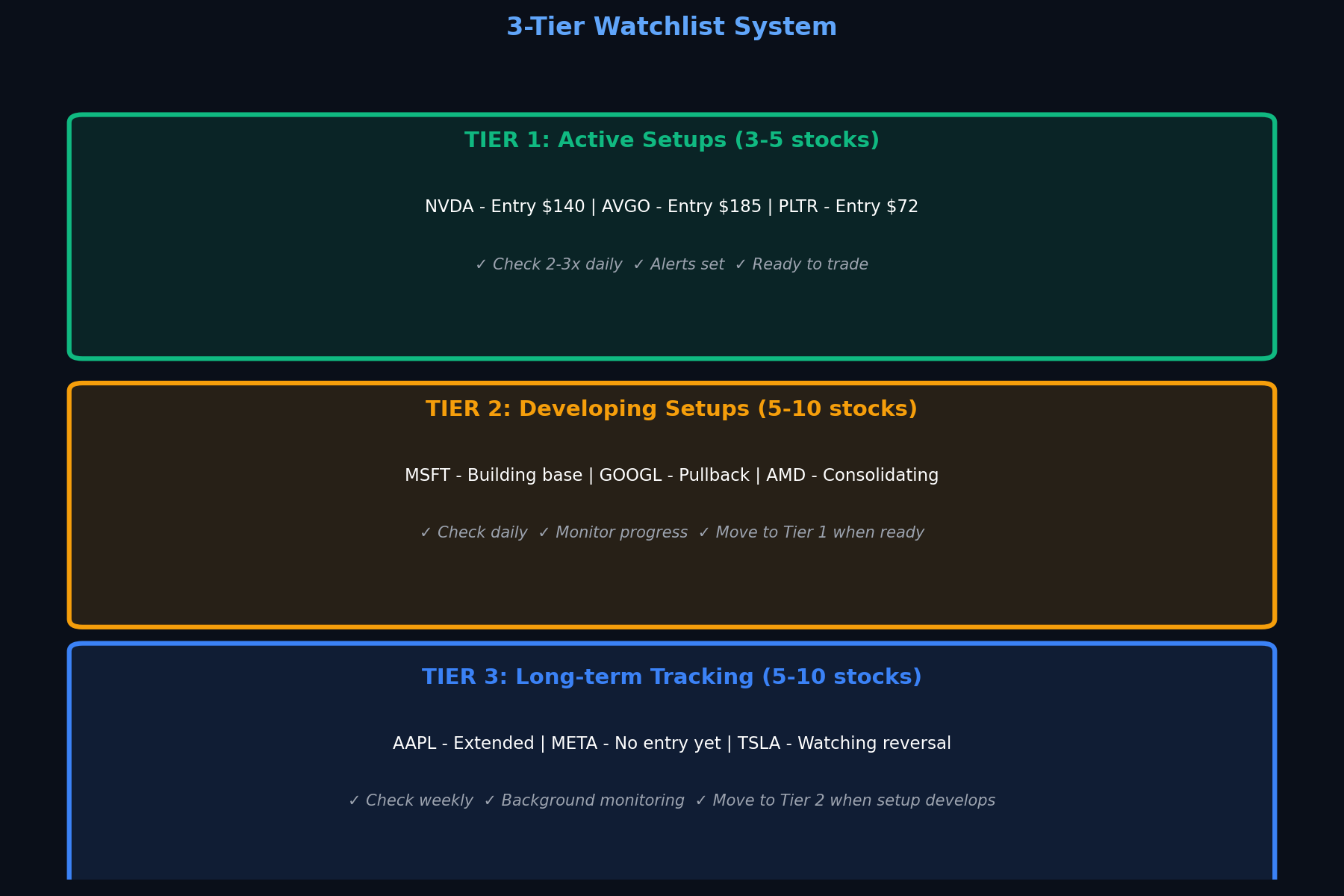
3-Tier Watchlist System
Visual representation of Tier 1, 2, and 3 stocks with example entries
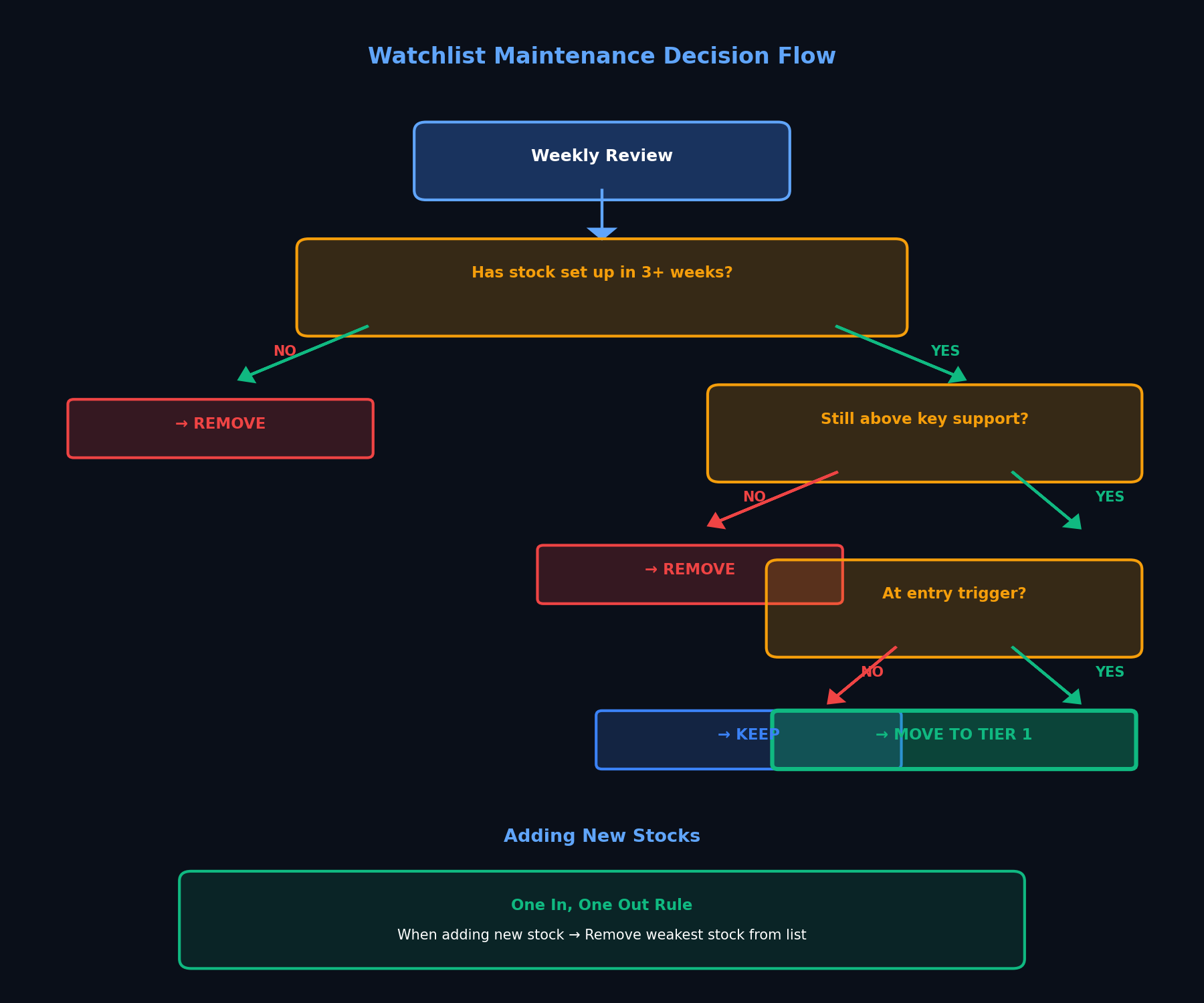
Watchlist Maintenance Flow
Decision tree for adding/removing stocks from watchlist
Why Most Watchlists Fail
The problem isn't the stocks - it's the approach. Here's what goes wrong:
Too many stocks: A watchlist with 50 stocks is useless. You can't track that many effectively, and most will never set up. A focused list of 10-20 stocks is far more valuable.
No clear criteria: Adding stocks because "they look interesting" leads to a random collection of names with no coherent strategy. You need specific criteria for what makes a stock watchlist-worthy.
Never updated: Stocks that were great setups 3 weeks ago might be terrible now. Watchlists need regular maintenance - add new setups, remove dead ones.
No action plan: A watchlist without entry triggers and price alerts is just a list of tickers. You need to know exactly what you're waiting for on each stock.
The 5-Minute Watchlist Framework
Here's how to build a quality watchlist from scratch in under 5 minutes:
Minute 1: Define Your Criteria
Pick ONE setup type you're hunting for this week:
- Breakouts: Stocks consolidating near highs
- Pullbacks: Strong stocks pulling back to support
- Reversals: Oversold stocks at major support
- Momentum: Stocks with strong relative strength
Don't try to track all setup types. Focus on one, master it, then expand.
Minute 2: Source Candidates (3 methods)
Use one of these fast sourcing methods:
- Method 1 - Sector leaders: Check the 3 strongest sectors, pick the 2-3 strongest stocks in each (6-9 stocks total)
- Method 2 - Screener: Run a quick screen with your criteria (covered in previous article)
- Method 3 - Market movers: Check top gainers/volume leaders, filter for quality setups
Pick the method that fits your style. I use sector leaders for swing trading.
Minute 3: Quick Quality Filter
For each candidate, check these 3 things (10 seconds per stock):
- ✓ Clean chart (no erratic gaps or wild swings)
- ✓ Decent volume (500K+ shares/day minimum)
- ✓ Clear setup (you can explain the trade in one sentence)
If it passes all 3, add it. If not, skip it. Don't overthink.
Minute 4: Add Entry Triggers
For each stock on your list, note:
- Entry trigger: What price/event makes this tradeable?
- Stop level: Where would you be wrong?
- Why it's here: One sentence explaining the setup
Example: "NVDA - Entry $140 breakout, stop $137, consolidation after strong move"
Minute 5: Set Alerts
Set price alerts for each stock:
- Alert at entry trigger (so you don't miss the setup)
- Alert at stop level (for risk management)
- Optional: Alert at target level
Now you're done. The market will tell you when to pay attention.
Watchlist Structure by Strategy
Different trading styles need different watchlist structures:
| Strategy | List Size | Update Frequency | Key Criteria |
|---|---|---|---|
| Swing Trading | 10-15 stocks | Weekly | Clean trends, key levels nearby |
| Day Trading | 5-10 stocks | Daily | High volume, volatility, liquidity |
| Position Trading | 5-8 stocks | Monthly | Major trends, strong fundamentals |
| Momentum | 15-20 stocks | 2-3x per week | Relative strength, breakouts |
The 3-Tier Watchlist System
Instead of one giant list, organize stocks into 3 tiers:
Tier 1: Active Setups (3-5 stocks)
Stocks that could trigger TODAY or this week:
- At key entry levels right now
- Have price alerts set
- Check these 2-3x per day
- Entry plan is ready to execute
These are your "hot" setups. Most of your attention goes here.
Tier 2: Developing Setups (5-10 stocks)
Stocks building patterns but not ready yet:
- Good structure but need more time
- Consolidating or pulling back
- Check these once per day
- Will move to Tier 1 when ready
These are your "warm" setups. Monitor but don't obsess.
Tier 3: Long-term Tracking (5-10 stocks)
Stocks you like but aren't ready to trade:
- Strong long-term trends
- Not at entry points yet
- Check these weekly
- Will move to Tier 2 when setup develops
These are your "cold" setups. Background monitoring only.
Watchlist Maintenance Rules
Rule #1: Weekly purge
Every Sunday, remove stocks that:
- Haven't set up in 3+ weeks
- Broke key support levels
- Lost their technical structure
- You can't remember why you added them
Rule #2: One in, one out
When adding a new stock, remove one. This forces you to prioritize and keeps your list focused. If you can't decide what to remove, the new stock probably isn't that great.
Rule #3: Document everything
For each stock, write down:
- Date added
- Why you added it (the setup)
- Entry trigger and stop level
- Any relevant notes
Rule #4: Review outcomes
Track which watchlist stocks you actually traded and how they performed. After 20-30 trades, you'll see patterns in what setups work for you.
Common Watchlist Mistakes
Mistake #1: Adding stocks you'll never trade
If a stock doesn't fit your strategy, don't add it. Just because TSLA is moving doesn't mean it belongs on your swing trading watchlist if you only trade pullbacks.
Mistake #2: No clear entry plan
A watchlist without entry triggers is useless. You need to know exactly what price or event makes each stock tradeable. Otherwise you're just collecting tickers.
Mistake #3: Ignoring market context
Your watchlist should adapt to market conditions. In strong bull markets, focus on breakouts. In choppy markets, focus on range-bound plays. In bear markets, focus on shorts or stay in cash.
Mistake #4: Never removing stocks
Stocks that were great setups 2 months ago might be terrible now. If a stock hasn't set up in 3+ weeks, remove it. You can always add it back later if the setup returns.
Real Example: My Current Watchlist
Here's my actual watchlist as of January 30, 2026:
Tier 1: Active Setups
- NVDA: Entry $140 breakout, stop $137, tight consolidation after strong move
- AVGO: Entry $185 breakout, stop $180, new ATH setup
- PLTR: Entry $72 breakout, stop $69, flag pattern
Tier 2: Developing Setups
- MSFT: Building base, needs 2 more weeks
- GOOGL: Pulling back to 50MA, watching for bounce
- AMD: Consolidating, volume declining (good)
- AMAT: Strong RS, waiting for pullback entry
- LRCX: Breaking out of 6-week base, needs confirmation
Tier 3: Long-term Tracking
- AAPL: Strong trend but extended, waiting for pullback
- META: Great structure but no entry yet
- TSLA: Watching for reversal setup
Total: 11 stocks. Tier 1 gets 80% of my attention, Tier 2 gets 15%, Tier 3 gets 5%.
Advanced Watchlist Tips
Use sector rotation: Instead of random stocks, focus on the 2-3 strongest sectors. This dramatically improves your hit rate because you're trading with sector momentum.
Track related stocks: If you're watching NVDA, also watch AMD and AVGO. When one breaks out, others often follow. This gives you multiple opportunities from one setup idea.
Set calendar reminders: For stocks in Tier 2-3, set calendar reminders to check them weekly. This prevents you from forgetting about developing setups.
Use color coding: Green for bullish setups, red for bearish, yellow for neutral. This makes it easy to see at a glance what you're hunting for.
The Bottom Line
A quality watchlist isn't about having the most stocks - it's about having the RIGHT stocks with clear entry plans. The 5-minute framework forces you to be selective and systematic.
Most traders fail because they track too many stocks without clear criteria. They waste time scrolling through noise instead of focusing on high-probability setups. The solution is a focused, tiered watchlist that you maintain religiously.
Start with 10-15 stocks maximum. Use the 3-tier system to organize by urgency. Update weekly. Remove dead setups ruthlessly. Within a few weeks, you'll have a watchlist that consistently delivers quality trading opportunities.
Continue Learning
Ready to Put This Into Practice?
Join MarketDly to access real-time market insights, AI-powered analysis, and professional trading tools.
No credit card required • Free tier available • Upgrade anytime