How to Screen Stocks in 5 Minutes
Fast and effective stock screening workflow. Learn the exact filters and process professional traders use to find quality stocks in under 5 minutes.
Most traders waste 30-60 minutes running stock screens, tweaking filters, and still end up with a list of mediocre stocks. They use too many filters, overthink the criteria, and get paralyzed by choice.
Professional traders screen thousands of stocks in under 5 minutes using a systematic approach with just 3-5 core filters. This guide shows you exactly how to do it.
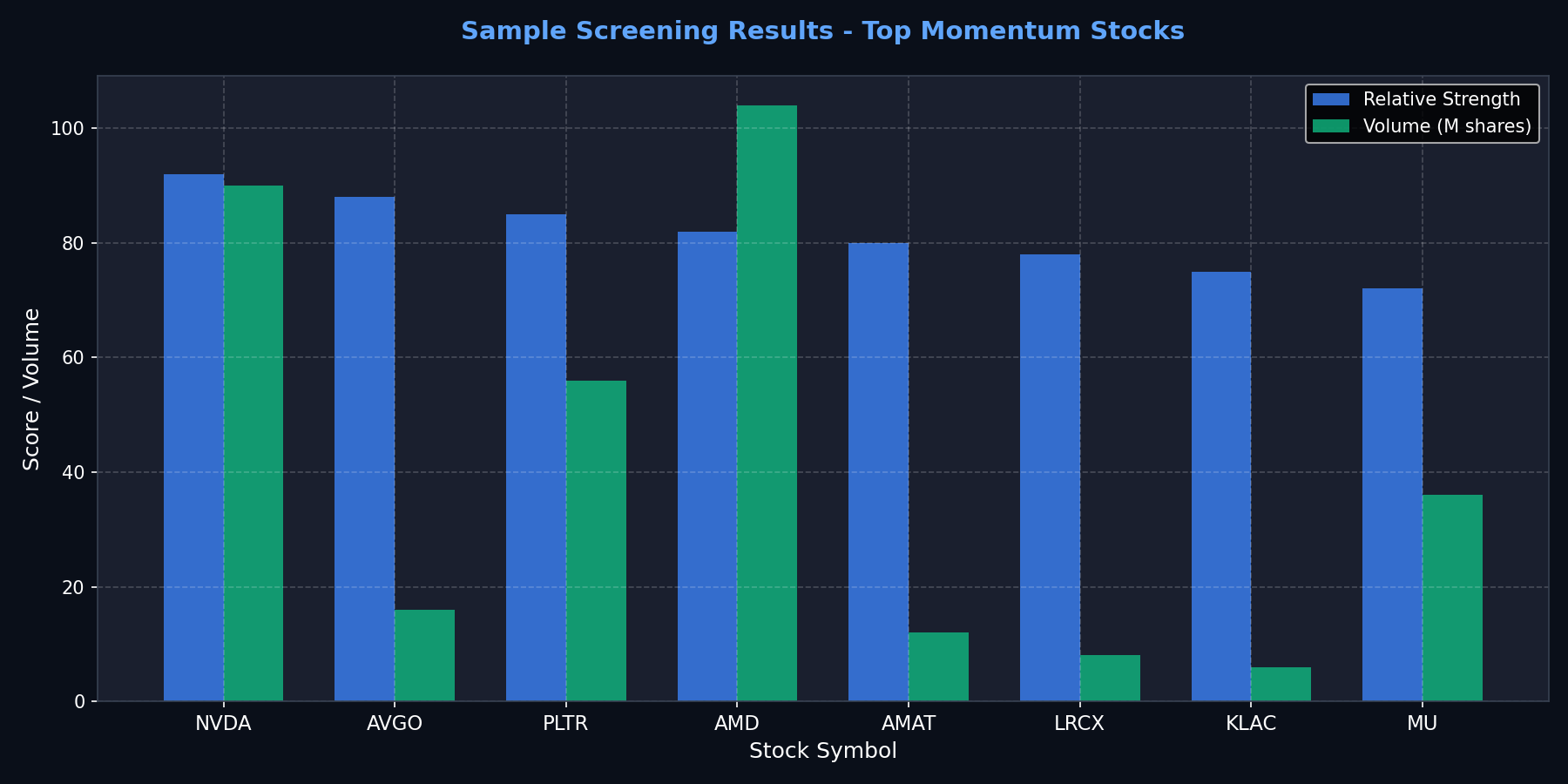
Sample Screening Results
Example of filtered results showing top momentum stocks with key metrics
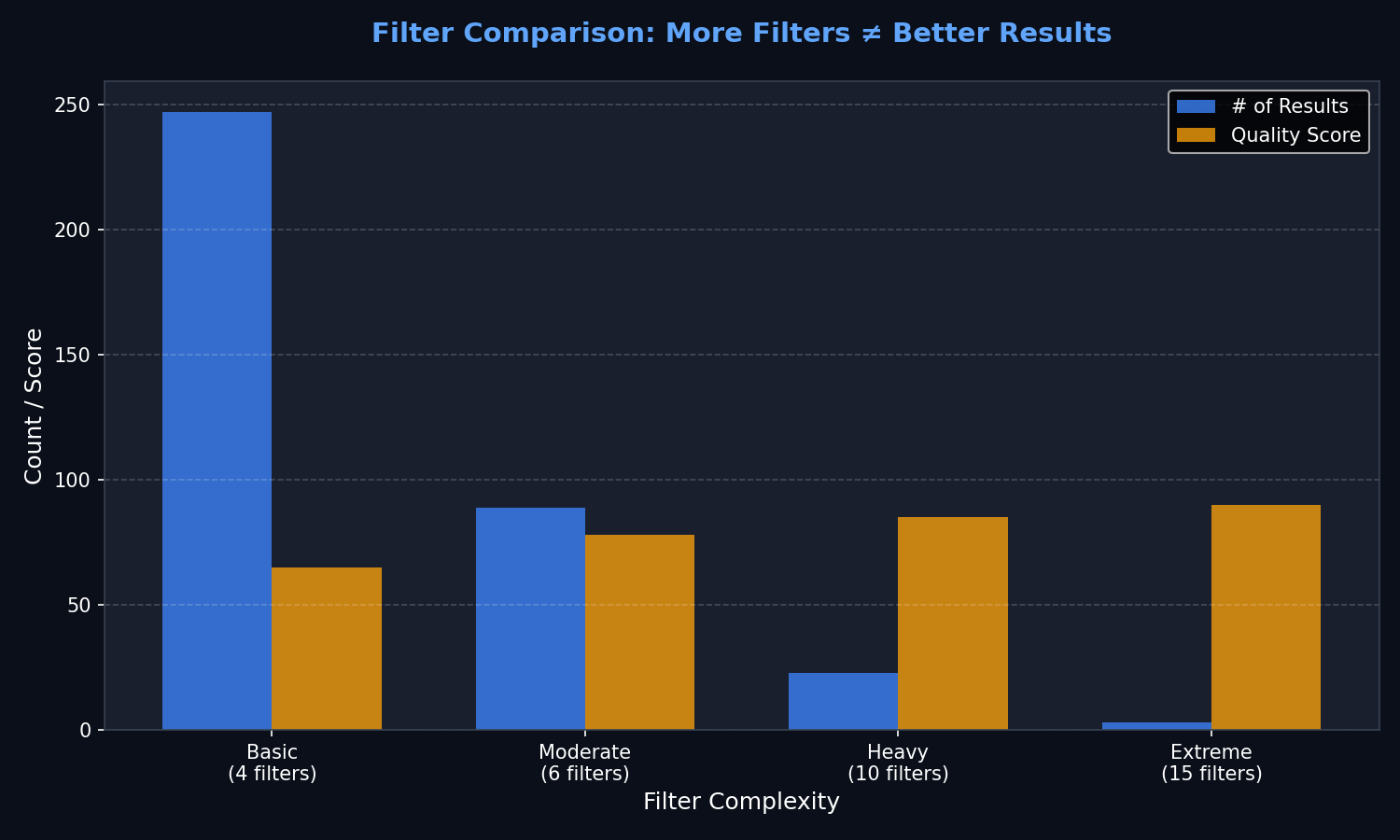
Filter Comparison
Visual comparison of different screening criteria and their results
Why Most Stock Screens Fail
The problem isn't the screening tool - it's the approach. Here's what goes wrong:
Too many filters: Adding 10+ criteria sounds thorough but actually eliminates good opportunities. Each filter you add reduces your universe exponentially. A stock might fail one arbitrary filter but still be an excellent trade.
Wrong priorities: Traders screen for fundamentals (P/E ratios, earnings growth) when they should focus on technical setup quality. Fundamentals matter for long-term investing, but for swing trading, price action and momentum are what drive short-term moves.
No systematic process: Running random screens based on "what feels right today" leads to inconsistent results. You need a repeatable workflow that works in all market conditions.
The 5-Minute Screening Framework
Here's the complete process, broken down step-by-step:
Minute 1: Set Core Filters
Start with these 4 essential filters only:
- Price: $5 - $500 (eliminates penny stocks and ultra-expensive shares)
- Volume: Minimum 500K shares/day (ensures liquidity)
- Market Cap: $300M+ (filters out micro-caps with manipulation risk)
- Relative Strength: Outperforming SPY over 20 days (momentum filter)
Minute 2: Apply Technical Filter
Add ONE technical criterion based on your strategy:
- For breakouts: Price within 5% of 52-week high
- For pullbacks: Price 10-20% below 52-week high, above 50-day MA
- For reversals: RSI below 30, price above 200-day MA
Pick ONE. Don't combine multiple technical filters - that's how you eliminate good setups.
Minute 3: Sort and Scan
Sort results by relative strength (highest first). Quickly scan the top 20-30 results:
- Look for clean chart patterns (no erratic gaps or wild swings)
- Check for institutional volume (large green volume bars on up days)
- Verify the trend is intact (higher highs and higher lows)
This visual scan takes 30 seconds per chart. You're not analyzing deeply - just eliminating obvious rejects.
Minute 4: Create Shortlist
From your scan, select 5-10 stocks that pass the visual test. Add them to a watchlist with these quick notes:
- Entry trigger (breakout level, support bounce, etc.)
- Initial stop level
- Why it caught your attention (1 sentence max)
Minute 5: Set Alerts
For each shortlisted stock, set price alerts at key levels:
- Alert above resistance (for breakout entries)
- Alert at support (for bounce entries)
- Alert below stop level (for risk management)
Now you're done. The market will tell you when to pay attention again.
Screening Criteria by Strategy
Different trading strategies require different screening approaches. Here are the optimal filters for each:
| Strategy | Core Filters | Technical Filter | Sort By |
|---|---|---|---|
| Momentum Breakout | Price $10+, Volume 1M+, RS > SPY | Within 5% of 52W high | Relative Strength |
| Pullback Entry | Price $15+, Volume 500K+, Above 200MA | 10-20% below 52W high | % Below High |
| Oversold Bounce | Price $5+, Volume 300K+, Market Cap $500M+ | RSI < 30, Above 200MA | RSI (lowest first) |
| Gap & Go | Price $10+, Volume 2M+, Float < 100M | Gap up 5%+, Volume 2x avg | Gap % (highest first) |
Common Screening Mistakes
Mistake #1: Using too many filters
Every filter you add cuts your results in half. Start with 4-5 core filters, then add ONE technical filter. That's it. If you're getting zero results, you're over-filtering.
Mistake #2: Screening for perfection
No stock will check every box. You're looking for stocks with edge, not perfect setups. A stock can have mediocre fundamentals but excellent technical setup - that's still tradeable.
Mistake #3: Ignoring market context
Your screening criteria should adapt to market conditions. In strong bull markets, screen for breakouts. In choppy markets, screen for oversold bounces. In bear markets, screen for short setups or stay in cash.
Mistake #4: Not tracking results
Keep a simple log of which screening criteria produce the best setups. After 20-30 trades, you'll see patterns. Maybe breakout screens work better for you than pullback screens. Double down on what works.
Best Free Screening Tools
You don't need expensive software. These free tools handle 90% of screening needs:
Finviz (Free Version)
Best for: Quick technical screens
Pros: Fast, visual charts, good filter options
Cons: 15-minute delayed data, limited to US stocks
Perfect for swing traders who don't need real-time data.
TradingView (Free)
Best for: Custom technical screens
Pros: Powerful charting, global markets, custom indicators
Cons: Steeper learning curve, limited free screens
Best if you want to create complex technical criteria.
MarketDly
Best for: Pre-screened swing setups
Pros: AI-analyzed setups, risk/reward calculated, daily updates
Cons: Focused on swing trading only
Skip the screening entirely - get pre-analyzed setups delivered daily.
Sample 5-Minute Screen (Real Example)
Here's exactly how I screened for momentum breakouts on January 29, 2026:
Filters Applied:
- ✓ Price: $10 - $300
- ✓ Volume: 1M+ shares/day
- ✓ Market Cap: $500M+
- ✓ Relative Strength: Outperforming SPY (20 days)
- ✓ Technical: Within 3% of 52-week high
Results: 47 stocks
After visual scan: 8 stocks shortlisted
Top 3 setups:
- NVDA: Breaking out of 3-week consolidation, volume surge
- AVGO: New ATH, clean uptrend, institutional buying
- PLTR: Tight flag pattern, above all MAs, strong RS
Total time: 4 minutes 30 seconds
Advanced Tips
Save your best screens: Once you find screening criteria that consistently produce good setups, save them as templates. Run the same screen daily - don't reinvent the wheel.
Screen at the same time daily: Market open, lunch, or after close. Consistency helps you spot patterns and compare results day-to-day.
Use sector rotation: Instead of screening the entire market, focus on the 2-3 strongest sectors. This dramatically reduces noise and improves hit rate.
Combine with watchlists: Don't just screen for new stocks. Also check your existing watchlist for setups that are now triggering. Often your best trades come from stocks you've been watching for weeks.
The Bottom Line
Effective stock screening isn't about finding the "perfect" stock - it's about efficiently identifying stocks with edge. Use 4-5 core filters, add ONE technical filter, and spend your time on execution rather than endless screening.
The 5-minute framework works because it forces you to focus on what matters: liquidity, momentum, and technical setup quality. Everything else is noise.
Start with the basic framework, track your results, and refine based on what actually produces winning trades. Within a few weeks, you'll have a screening process that consistently delivers quality setups in under 5 minutes.
Ready to Put This Into Practice?
Join MarketDly to access real-time market insights, AI-powered analysis, and professional trading tools.
No credit card required • Free tier available • Upgrade anytime