Advanced Support and Resistance Trading Strategies
Take your S&R trading to the professional level with advanced strategies: role reversal, false breakouts, supply/demand zones, and multi-timeframe analysis.
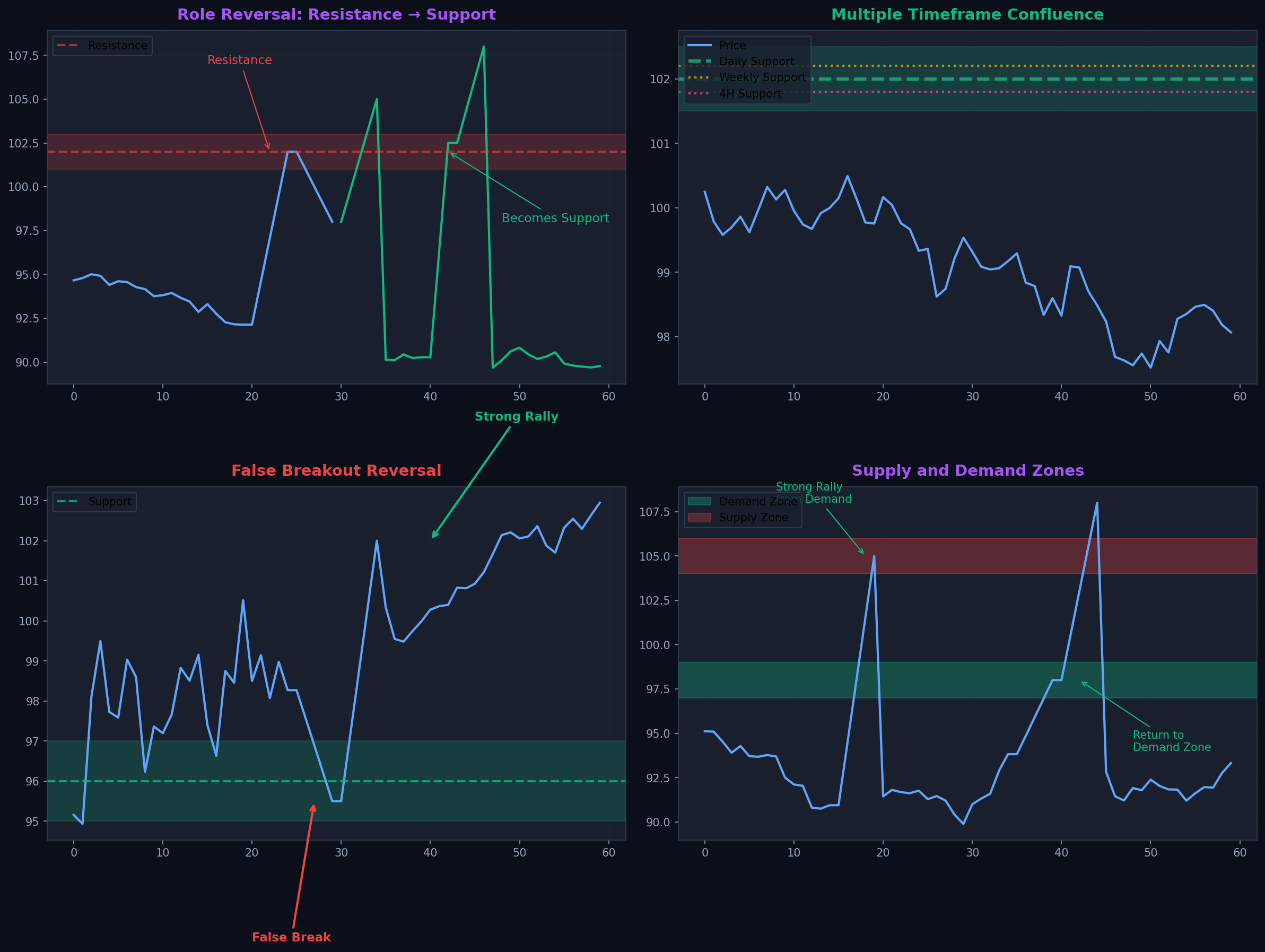
Strategy 1: Role Reversal Trading
The most reliable S&R strategy - trading the flip when support becomes resistance or vice versa.
The Setup
- Identify a well-established support or resistance level (3+ touches)
- Wait for a clean break with strong volume
- Price pulls back to retest the broken level
- Level now acts as opposite role (support → resistance or vice versa)
Entry Rules
- Entry: When price retests broken level and shows rejection
- Confirmation: Bearish candle at old support (now resistance) or bullish at old resistance (now support)
- Stop Loss: Beyond the retest high/low
- Target: Next major S&R level or 3:1 risk-reward
Why It Works: Traders who bought at support and held through the break want to exit at breakeven. New shorts enter at old support (now resistance). This creates strong selling pressure.
Success Rate
70-80% when all conditions are met. One of the highest probability setups in technical analysis.
Strategy 2: False Breakout Reversal
Capitalize on failed breakouts that trap traders on the wrong side.
Identifying False Breakouts
- Low volume break: Breakout without volume spike is suspect
- Quick reversal: Price breaks level but closes back inside same day
- Wick rejection: Long wick beyond level, body closes inside
- No follow-through: Break occurs but price doesn't continue
Trading the Reversal
- Entry: When price closes back inside the S&R level
- Stop Loss: Beyond the false breakout extreme
- Target: Opposite side of range or previous swing
- Advantage: Trapped traders forced to exit, creating momentum
Pro Insight: False breakouts often lead to strong moves in the opposite direction as stop losses trigger and trapped traders panic.
Strategy 3: Multi-Timeframe Confluence
The most powerful S&R setups occur when multiple timeframes align.
The Process
- Start with higher timeframe: Identify major S&R on weekly/daily
- Drop to intermediate: Find S&R on 4H/1H that aligns
- Use lower timeframe for entry: 15min/5min for precise timing
- Trade when all align: Weekly + Daily + 4H support at same zone
| Timeframe | Purpose | Action |
|---|---|---|
| Weekly/Monthly | Major S&R levels | Identify key zones |
| Daily | Trend direction | Confirm alignment |
| 4H/1H | Setup identification | Wait for confluence |
| 15min/5min | Entry timing | Execute trade |
Entry Rules
- Requirement: Minimum 2 timeframes showing S&R at same level
- Entry: Lower timeframe reversal signal at the confluence zone
- Stop Loss: Based on higher timeframe structure
- Target: Next higher timeframe S&R level
Strategy 4: Supply and Demand Zones
Advanced S&R concept focusing on where institutional orders concentrate.
Identifying Supply Zones (Resistance)
- Look for areas where price rallied strongly then reversed sharply
- The consolidation before the drop is the supply zone
- Institutions distributed (sold) in this zone
- When price returns, expect selling pressure
Identifying Demand Zones (Support)
- Look for areas where price dropped strongly then rallied sharply
- The consolidation before the rally is the demand zone
- Institutions accumulated (bought) in this zone
- When price returns, expect buying pressure
Trading Supply/Demand Zones
- Entry: First touch of fresh zone (untested zones are strongest)
- Confirmation: Reversal candle pattern at zone edge
- Stop Loss: Beyond the zone
- Target: Opposite supply/demand zone
- Note: Zones weaken after multiple tests
Key Difference: Supply/demand zones focus on where institutional orders were placed, not just where price reversed. This makes them more reliable than simple S&R.
Strategy 5: Volume Profile S&R
Use volume to identify the strongest S&R levels.
High Volume Nodes (HVN)
- Price levels where most trading occurred
- Act as strong support/resistance
- Represent fair value - price tends to return here
- Look for volume spikes on your chart
Low Volume Nodes (LVN)
- Price levels where little trading occurred
- Weak S&R - price moves through quickly
- Represent unfair value - price doesn't stay here
- Good for targeting quick moves
Strategy 6: Order Block Trading
Identify where large institutional orders were placed.
What Are Order Blocks?
The last consolidation before a strong move. This is where institutions placed large orders that moved the market.
Bullish Order Block
- Last down candle before strong rally
- Acts as support when price returns
- Institutions bought here, will defend this level
Bearish Order Block
- Last up candle before strong decline
- Acts as resistance when price returns
- Institutions sold here, will defend this level
Risk Management for Advanced Strategies
| Strategy | Risk Per Trade | Min R:R |
|---|---|---|
| Role Reversal | 1-2% | 2:1 |
| False Breakout | 1-2% | 2:1 |
| Multi-Timeframe | 1-2% | 3:1 |
| Supply/Demand | 1-2% | 3:1 |
| Volume Profile | 1-2% | 2:1 |
| Order Blocks | 1-2% | 3:1 |
Combining Strategies
The highest probability setups combine multiple advanced concepts:
Example: Perfect Setup
- ✅ Weekly support level (multi-timeframe)
- ✅ Previous resistance now support (role reversal)
- ✅ Round number $100 (psychological)
- ✅ 200 MA nearby (dynamic support)
- ✅ High volume node (volume profile)
- ✅ Fresh demand zone (supply/demand)
Result: 85%+ win rate with 3:1+ risk-reward
Key Takeaways
- ✅ Role reversal is the highest probability S&R strategy (70-80%)
- ✅ False breakouts create strong reversal opportunities
- ✅ Multi-timeframe confluence dramatically improves win rate
- ✅ Supply/demand zones show where institutions placed orders
- ✅ Volume profile identifies strongest S&R levels
- ✅ Order blocks mark institutional entry points
- ✅ Combining multiple strategies creates highest probability setups
- ✅ Always use proper risk management (1-2% per trade)
Related Articles
Ready to Put This Into Practice?
Join MarketDly to access real-time market insights, AI-powered analysis, and professional trading tools.
No credit card required • Free tier available • Upgrade anytime