Stochastic Oscillator Trading Strategy
Master the Stochastic Oscillator for identifying overbought/oversold conditions and catching reversals. Learn %K/%D calculation, crossover signals, and divergence patterns.
What is the Stochastic Oscillator?
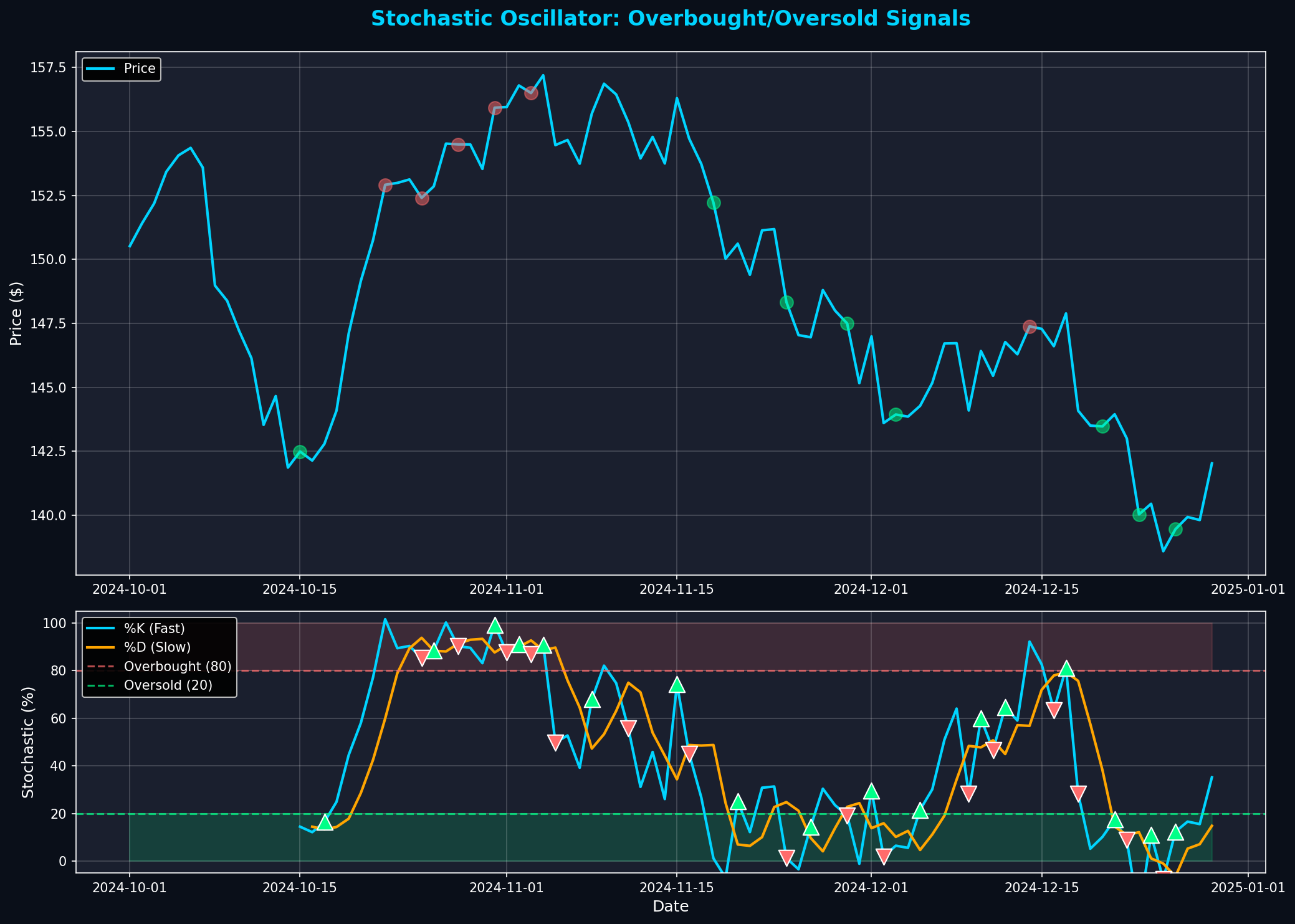
The Stochastic Oscillator, developed by George Lane in the 1950s, measures where the current close is relative to the recent price range. It oscillates between 0 and 100, with readings above 80 indicating overbought conditions and below 20 indicating oversold.
Unlike momentum indicators that measure speed of price change, Stochastic measures the location of the close relative to the high-low range. This makes it excellent for identifying potential reversal points when price reaches extremes.
Key Insight: Stochastic can stay overbought/oversold for extended periods in strong trends. Always trade with the trend - buy oversold in uptrends, sell overbought in downtrends.
Stochastic Formula
%K Line (Fast Stochastic)
Where:
- C = Most recent closing price
- L14 = Lowest low over last 14 periods
- H14 = Highest high over last 14 periods
Example: Close $55, 14-day low $50, 14-day high $60
%K = [(55 - 50) / (60 - 50)] × 100 = 50
%D Line (Slow Stochastic)
Smoothed version of %K, acts as signal line
Fast vs Slow Stochastic
- Fast Stochastic: %K (14) and %D (3) - More sensitive, more signals
- Slow Stochastic: %K smoothed (3-period SMA) and %D (3) - Less noise, fewer false signals
- Recommendation: Use slow stochastic for swing trading to avoid whipsaws
Overbought/Oversold Zones
Oversold Zone (0-20)
- Meaning: Price near bottom of recent range, selling exhaustion
- Signal: Potential bounce/reversal coming
- Entry: Wait for %K to cross above %D while in oversold zone
- Caution: Can stay oversold in strong downtrends
Neutral Zone (20-80)
- Meaning: Normal trading range, no extreme
- Signal: No clear overbought/oversold signal
- Action: Wait for extremes or use other indicators
Overbought Zone (80-100)
- Meaning: Price near top of recent range, buying exhaustion
- Signal: Potential pullback/reversal coming
- Entry: Wait for %K to cross below %D while in overbought zone
- Caution: Can stay overbought in strong uptrends
Trading Signals
1. Bullish Crossover
Setup: %K crosses above %D in oversold zone (below 20)
- Strongest signal when both lines below 20
- Confirms momentum shifting from down to up
- Enter on candle close after crossover
- Stop below recent swing low
2. Bearish Crossover
Setup: %K crosses below %D in overbought zone (above 80)
- Strongest signal when both lines above 80
- Confirms momentum shifting from up to down
- Enter short on candle close after crossover
- Stop above recent swing high
3. Divergence Signals
Most powerful Stochastic signal - price and oscillator moving in opposite directions:
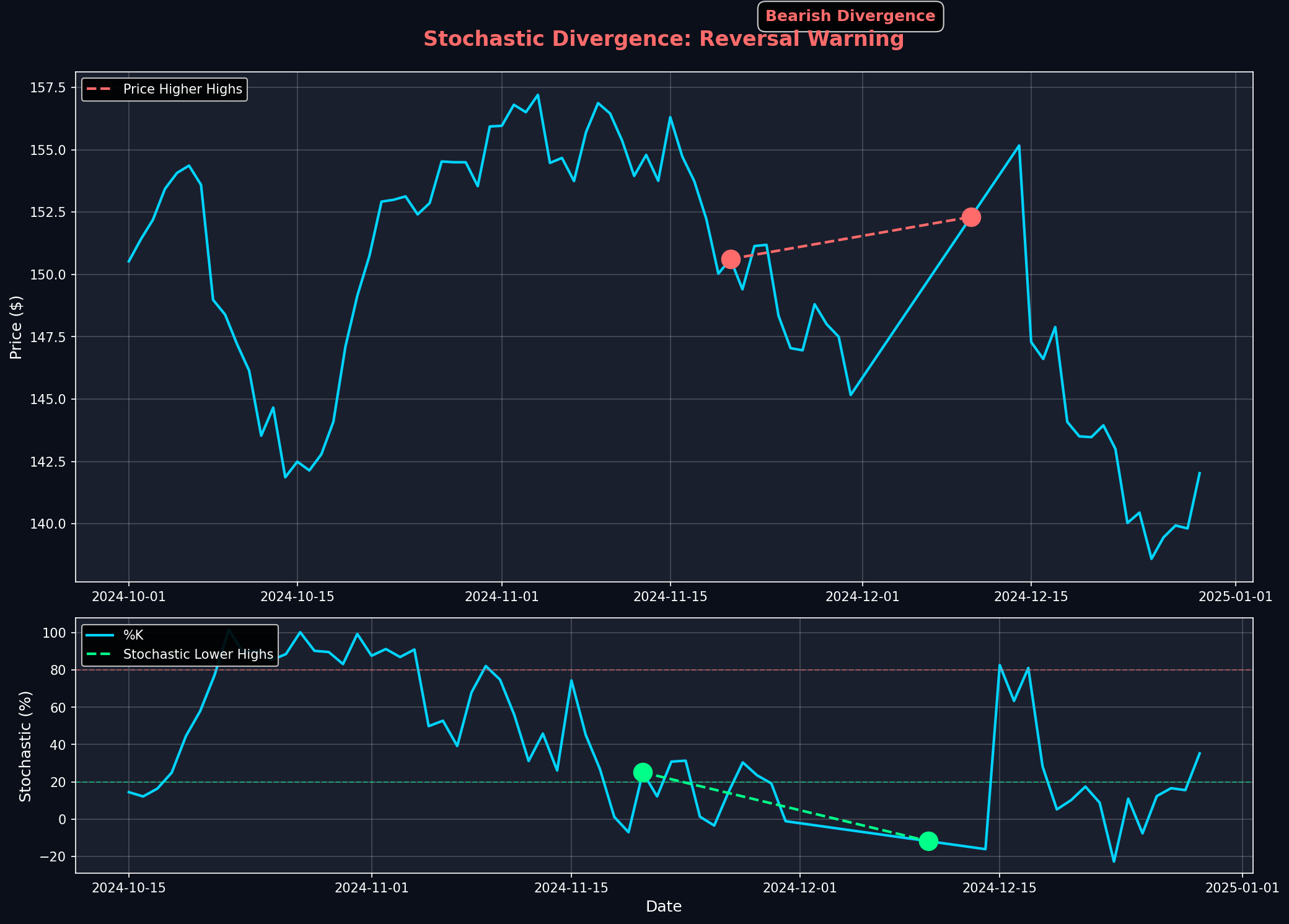
Bearish Divergence
- Price makes higher high
- Stochastic makes lower high
- Signals weakening uptrend, reversal likely
- Enter short when Stochastic crosses down from overbought
Bullish Divergence
- Price makes lower low
- Stochastic makes higher low
- Signals weakening downtrend, reversal likely
- Enter long when Stochastic crosses up from oversold
Trading Strategy
Trend-Following Approach (Recommended)
In Uptrends:
- Only take bullish signals (oversold bounces)
- Ignore overbought readings - trend can extend
- Buy when Stochastic crosses up from below 20
- Exit when Stochastic crosses down from above 80
In Downtrends:
- Only take bearish signals (overbought pullbacks)
- Ignore oversold readings - trend can extend
- Short when Stochastic crosses down from above 80
- Cover when Stochastic crosses up from below 20
Counter-Trend Approach (Advanced)
Warning: Counter-trend trading is risky. Only use in ranging markets.
- Buy oversold in downtrends (scalping bounces)
- Sell overbought in uptrends (scalping pullbacks)
- Use tight stops (2-3%)
- Take quick profits (5-10%)
Combining with Other Indicators
Stochastic + Moving Averages
- Price above 50-day MA + Stochastic oversold = buy signal
- Price below 50-day MA + Stochastic overbought = sell signal
- MA defines trend, Stochastic times entry
Stochastic + RSI
- Both oversold (Stoch < 20, RSI < 30) = strong buy
- Both overbought (Stoch > 80, RSI > 70) = strong sell
- Divergence on both = highest probability reversal
Stochastic + Support/Resistance
- Oversold at support level = high probability bounce
- Overbought at resistance = high probability rejection
- Confluence increases win rate significantly
Common Mistakes
- Trading Against Trend: Buying oversold in downtrends or selling overbought in uptrends leads to losses.
- No Confirmation: Don't enter on overbought/oversold alone. Wait for crossover confirmation.
- Wrong Timeframe: Use daily charts for swing trades. Intraday Stochastic produces too many false signals.
- Ignoring Divergence: Divergence is the most powerful signal - don't overlook it.
- No Stop Loss: Stochastic can stay extreme longer than you can stay solvent. Always use stops.
Key Takeaways
- •Stochastic measures where close is relative to recent range (0-100 scale)
- •Oversold < 20, Overbought > 80 - but can stay extreme in trends
- •%K crosses %D = entry signal (bullish up, bearish down)
- •Divergence (price vs Stochastic) = most powerful reversal signal
- •Trade with trend: buy oversold in uptrends, sell overbought in downtrends
- •Use slow Stochastic (smoothed) to reduce false signals
- •Combine with MA or support/resistance for higher probability
Get Stochastic Oscillator Alerts
MarketDly scans stocks for Stochastic crossovers and divergence signals in trending markets for high-probability entries.
View Pricing PlansReady to Put This Into Practice?
Join MarketDly to access real-time market insights, AI-powered analysis, and professional trading tools.
No credit card required • Free tier available • Upgrade anytime