Scaling In & Out: Advanced Position Management
When to add to winners (pyramiding) and when to scale out. The 1/3, 1/3, 1/3 method explained. Real examples: NVDA trade scaled from 100 to 300 shares.
The Power of Scaling
Adding to winners (pyramiding) can turn a 5% gain into 15%. Scaling out protects profits while letting winners run. This is how professionals maximize edge.
Pyramiding: Adding to Winners
The Pyramiding Rules
Rule 1: Only Add to Winning Positions
Never average down. Only add when the trade is working and in profit.
Rule 2: Each Add Should Be Smaller
First position: 100 shares. Second: 100 shares. Third: 100 shares (or smaller). Never increase size.
Rule 3: Move Stop to Breakeven
After adding, move your stop to protect the entire position. Never let a winner turn into a loser.
Rule 4: Maximum 3 Entries
Initial entry + 2 adds = 3 total entries. More than that is overtrading.
Real Example: NVDA Pyramiding
Trade Setup: NVDA Breakout
- • Entry 1: $190.00 (100 shares, $19,000 position)
- • Stop: $188.00 (risk $200)
- • Stock moves to $195.00 (+2.6%)
- • Entry 2: $195.00 (100 shares, add $19,500)
- • Move stop to $191.00 (breakeven on Entry 1)
- • Stock moves to $201.00 (+5.8% from Entry 1)
- • Entry 3: $201.00 (100 shares, add $20,100)
- • Move stop to $196.00 (protect all entries)
- • Stock moves to $210.00 (+10.5% from Entry 1)
- • Exit: Sell all 300 shares at $210.00
P&L Calculation:
- • Entry 1: 100 shares × ($210 - $190) = $2,000
- • Entry 2: 100 shares × ($210 - $195) = $1,500
- • Entry 3: 100 shares × ($210 - $201) = $900
- • Total Profit: $4,400
Compare to single 100-share entry: $2,000 profit. Pyramiding added $2,400 (120% more).
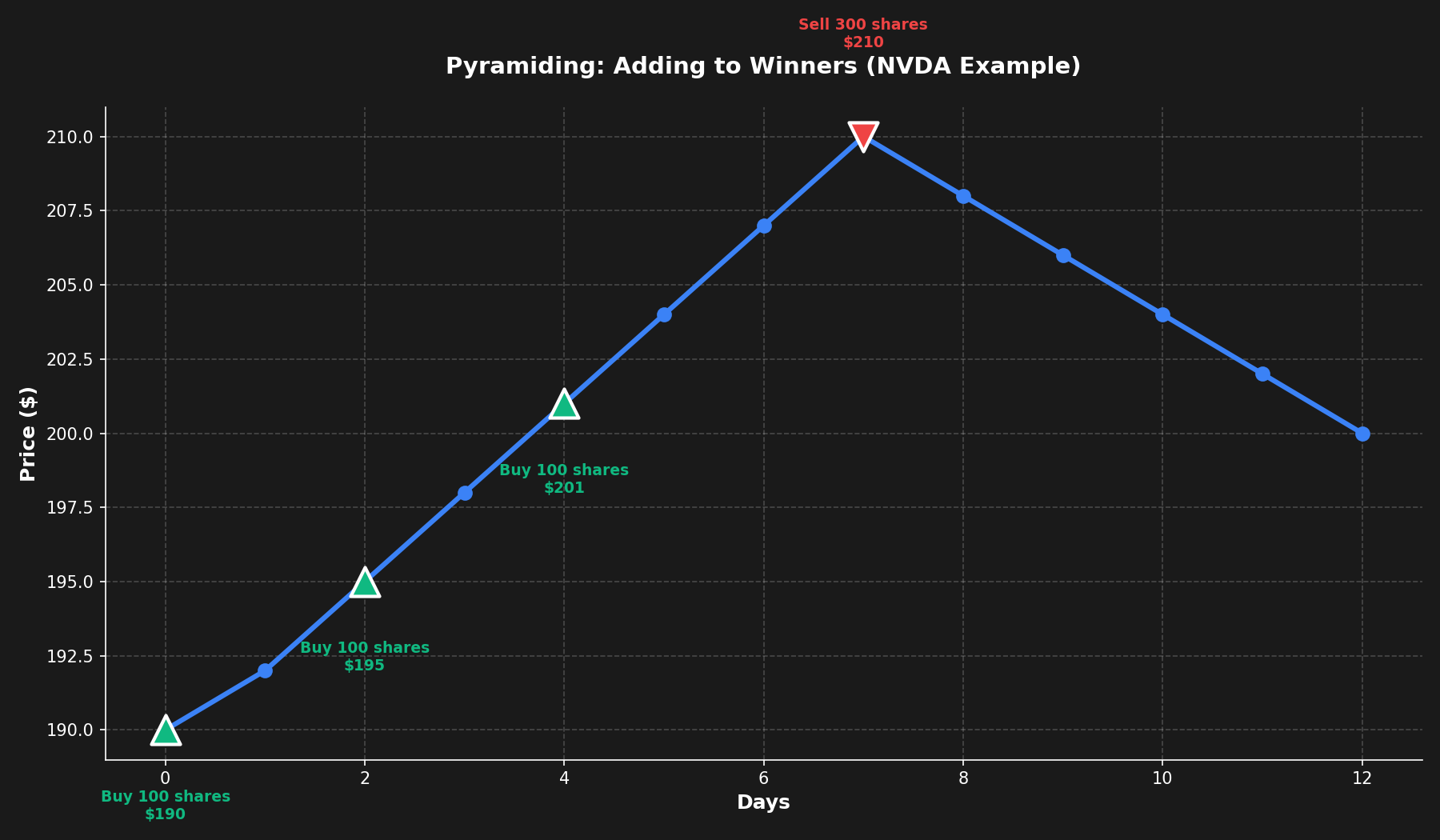
Chart: NVDA pyramiding - 3 entries as price confirms uptrend
Scaling Out: The 1/3, 1/3, 1/3 Method
Why Scale Out?
Scaling out solves the trader's dilemma: take profits too early and miss the big move, or hold too long and give back gains.
The Solution:
- • Sell 1/3 at Target 1 (lock in some profit)
- • Sell 1/3 at Target 2 (take more off)
- • Sell 1/3 at Target 3 or trail stop (let it run)
Real Example: Scaling Out
Trade: 300 Shares at $50.00
- • Entry: $50.00 (300 shares)
- • Stop: $48.00 (risk $600)
- • Target 1: $52.00 (+4%)
- • Target 2: $54.00 (+8%)
- • Target 3: $56.00 (+12%)
Execution:
- • Stock hits $52: Sell 100 shares (+$200 profit, 200 remain)
- • Move stop to $50.50 (protect remaining position)
- • Stock hits $54: Sell 100 shares (+$400 profit, 100 remain)
- • Move stop to $52.50 (lock in more profit)
- • Stock hits $56: Sell 100 shares (+$600 profit)
- • Total: $1,200 profit on 300 shares
Compare to All-or-Nothing:
- • Exit all at $52: $600 profit (missed $600)
- • Hold all to $56: $1,800 profit (but risky)
- • Scaling out: $1,200 profit with less stress
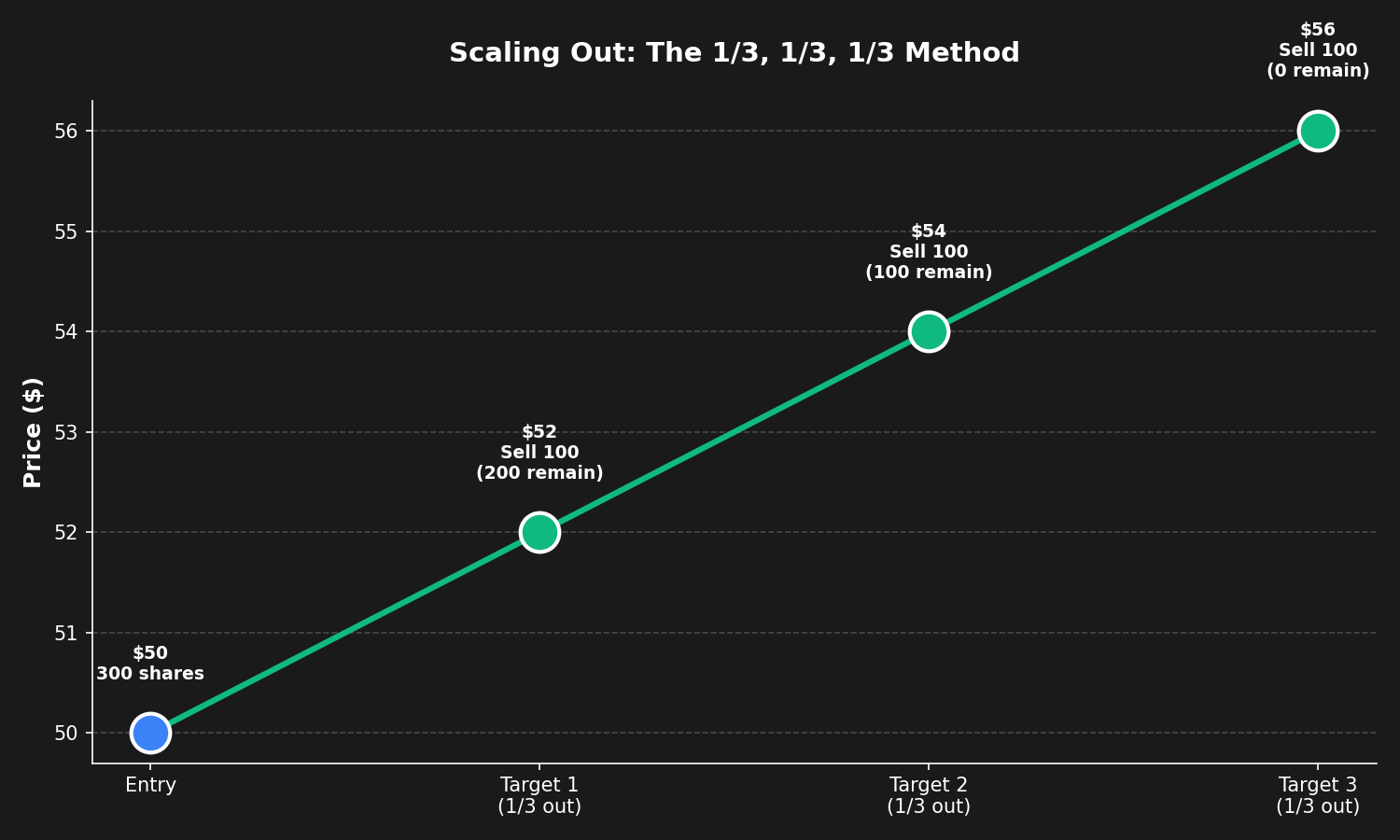
Chart: The 1/3, 1/3, 1/3 scaling out method
When NOT to Scale
❌ Don't Pyramid into Resistance
If stock is approaching major resistance, don't add. Wait for breakout confirmation.
❌ Don't Scale Out Too Early
If Target 1 is only +1%, you're taking profits too fast. Minimum +2% per scale level.
❌ Don't Add to Losers
Averaging down is not pyramiding. Only add when trade is working.
The Bottom Line
Pyramiding lets you maximize winners. Scaling out protects profits while letting some run. Both require discipline: only add to winners, always protect your capital, and follow your plan.
The best trades deserve more size. The best profits deserve protection.
Ready to Apply These Strategies?
Get real-time market insights, AI-powered analysis, and professional-grade tools.