Advanced Moving Average Techniques
After mastering basic moving averages, crossovers, and multi-MA systems, it's time to explore advanced techniques that can give you an edge in modern markets. This article covers adaptive moving averages, displaced MAs, envelope strategies, and powerful indicator combinations used by professional traders.
💡 What You'll Learn
- Adaptive moving averages (KAMA, VIDYA) that adjust to volatility
- Displaced MAs to reduce whipsaws and false signals
- MA envelopes and channels for mean reversion trading
- Combining MAs with RSI, MACD, and volume for confluence
- Advanced filtering techniques to improve win rates
Adaptive Moving Averages
Traditional moving averages use fixed periods, but markets alternate between trending and ranging conditions. Adaptive moving averages automatically adjust their sensitivity based on market volatility and trend strength.
Kaufman's Adaptive Moving Average (KAMA)
Developed by Perry Kaufman, KAMA adjusts its smoothing constant based on the Efficiency Ratio (ER), which measures how efficiently price is moving in one direction versus random noise.
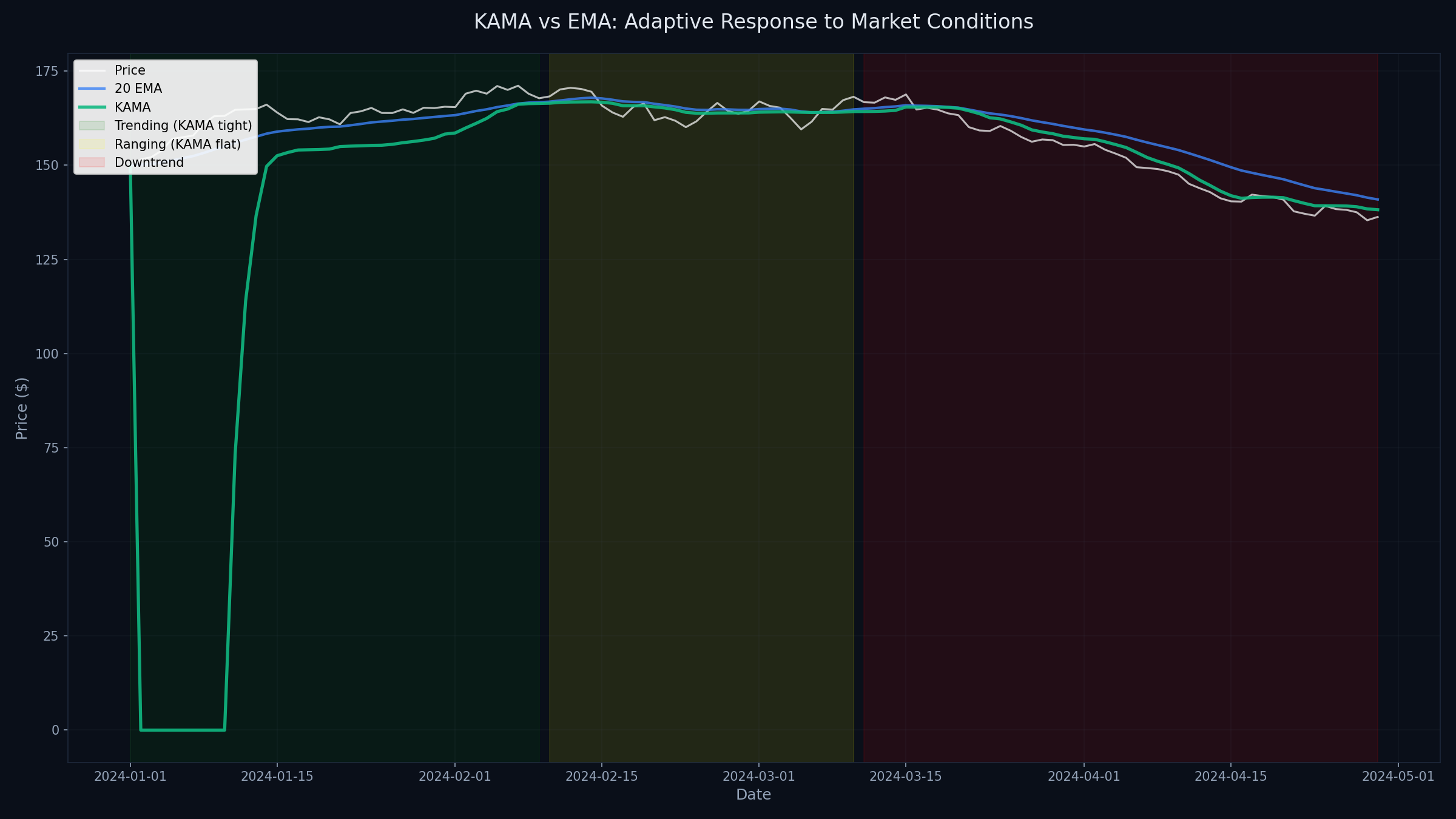
KAMA Calculation:
- Efficiency Ratio (ER) = Change / Volatility
- Change = |Close - Close[10 periods ago]|
- Volatility = Sum of |Close - Close[1]| over 10 periods
- Smoothing Constant (SC) = [ER × (Fast SC - Slow SC) + Slow SC]²
- KAMA = KAMA[previous] + SC × (Price - KAMA[previous])
Key Advantage: Stays close to price during strong trends, flattens during choppy markets to avoid whipsaws.
Variable Index Dynamic Average (VIDYA)
VIDYA uses volatility (typically standard deviation or CMO) to adjust the EMA's alpha parameter. When volatility is high, VIDYA becomes more responsive; when volatility is low, it smooths more aggressively.
✅ When to Use Adaptive MAs
- Volatile markets: Crypto, small-cap stocks, forex during news events
- Swing trading: Reduces false signals during consolidation
- Trend following: Stays closer to price during strong moves
- Avoid: Very short-term scalping (lag still exists)
Displaced Moving Averages
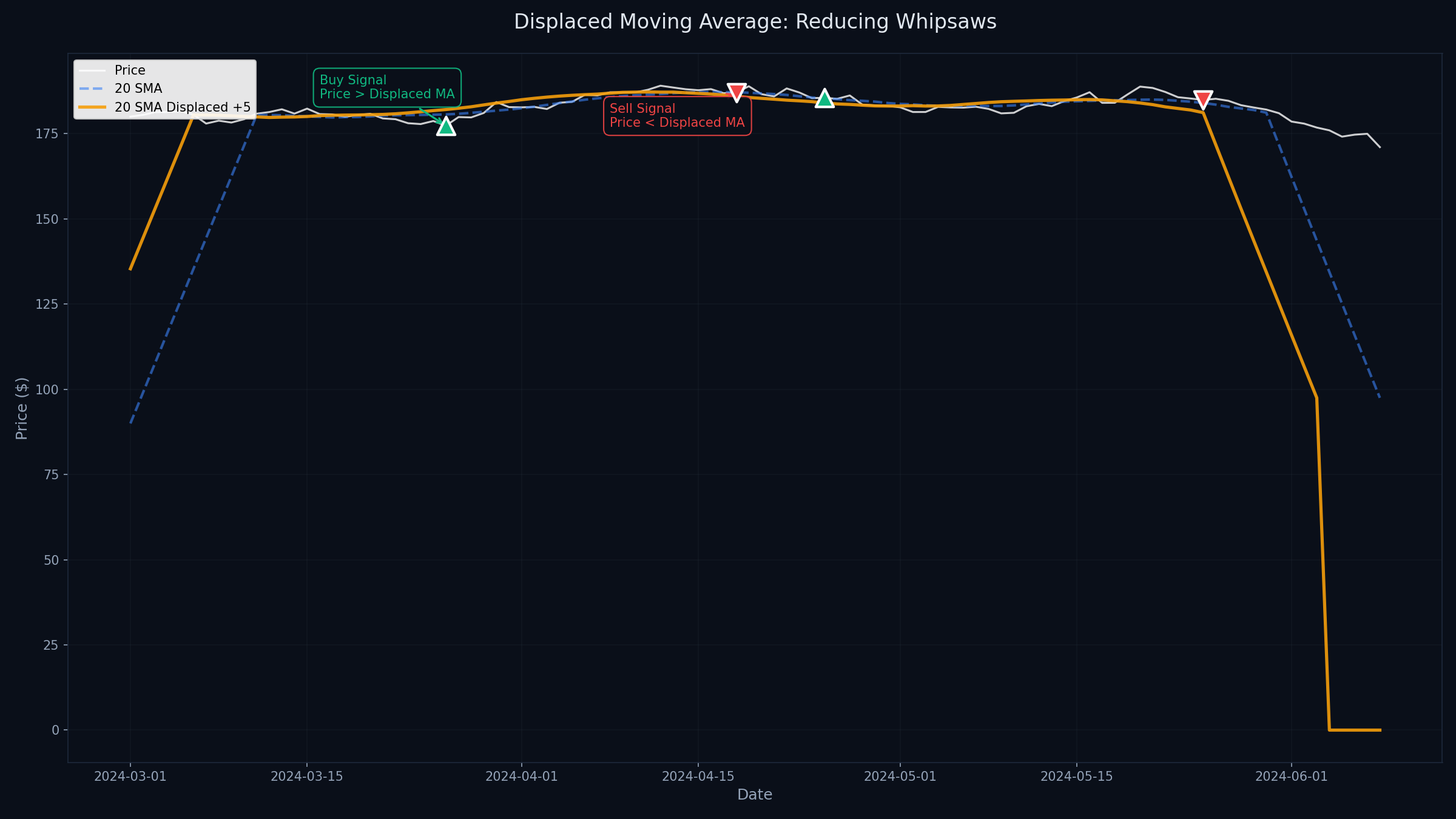
A displaced moving average is simply a regular MA shifted forward or backward in time. This technique, popularized by Joe DiNapoli, helps reduce whipsaws and provides clearer support/resistance levels.
How Displacement Works
Instead of plotting the MA at the current bar, you shift it forward (positive displacement) or backward (negative displacement) by a specified number of periods.
- Positive displacement (+3 to +5): Shifts MA into the future, creating a "buffer zone" that price must clearly break through
- Negative displacement (-3 to -5): Shifts MA into the past, useful for identifying historical support/resistance
DiNapoli's 3x3 Displaced MA Strategy:
Setup:
- • 3-period SMA displaced +3 periods (3x3 DMA)
- • Works on any timeframe (daily, 4H, 1H)
- • Best for trending markets
Entry Rules:
- • Long: Price closes above 3x3 DMA + uptrend confirmed
- • Short: Price closes below 3x3 DMA + downtrend confirmed
- • Stop Loss: Below/above recent swing low/high
- • Exit: When price closes on opposite side of DMA
📈 Real Example: NVDA 3x3 DMA Trade
Date: October 2024
Setup: NVDA broke above 3x3 DMA at $128.50 on daily chart after earnings
- • Entry: $129.00 (close above DMA)
- • Stop Loss: $125.50 (below swing low)
- • Exit: $142.80 (price closed below DMA after 12 days)
- • Result: +10.7% gain, held through minor pullbacks
Key Insight: Displacement prevented premature exit during normal pullbacks that touched but didn't close below the DMA.
Moving Average Envelopes
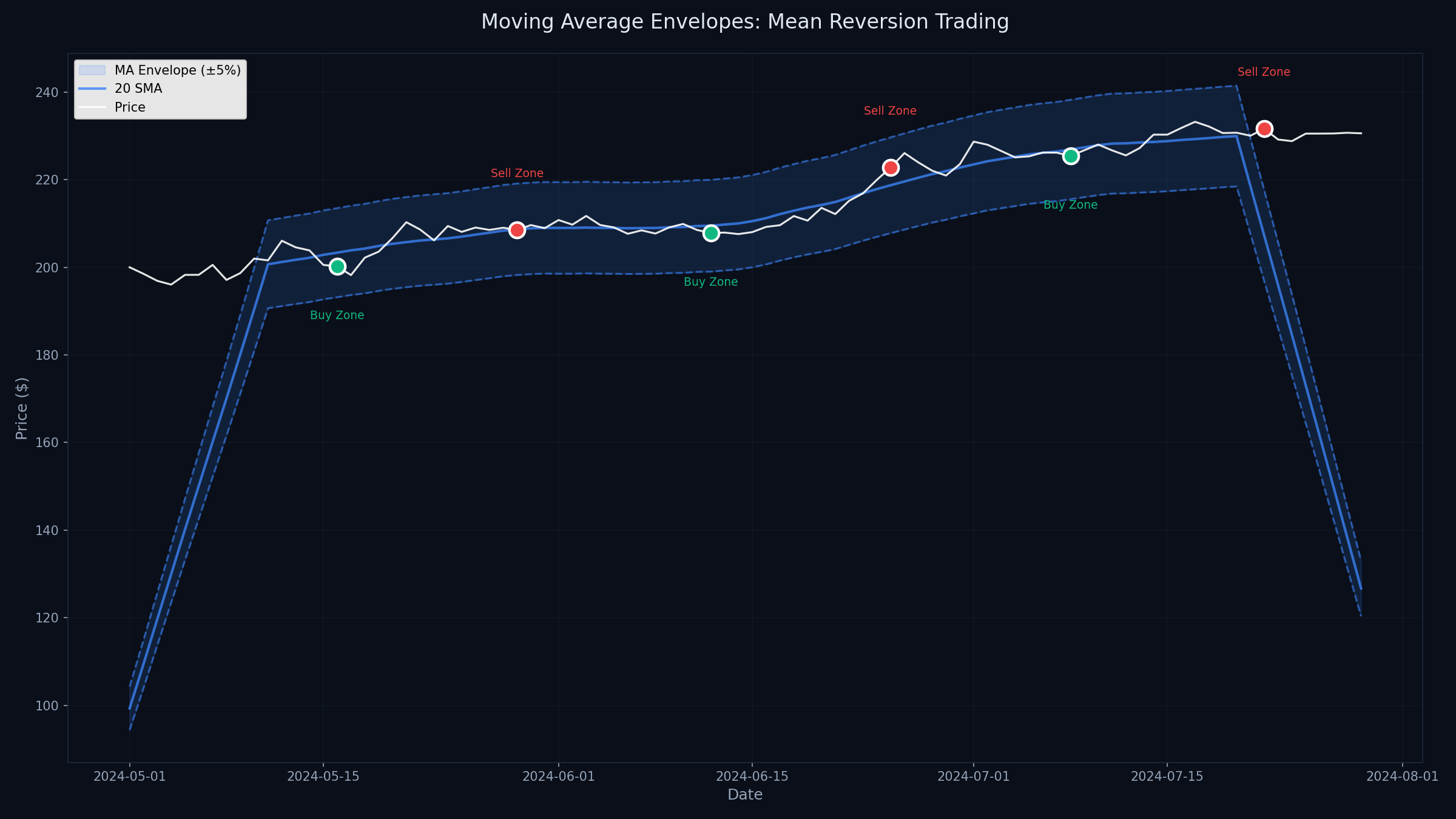
MA envelopes are percentage-based bands plotted above and below a moving average. They create a channel that price oscillates within, perfect for mean reversion strategies.
Envelope Trading Strategy
Unlike Bollinger Bands (which use standard deviation), envelopes use fixed percentages, making them more predictable in certain market conditions.
Mean Reversion Envelope System:
Setup:
- • 20-period SMA (center line)
- • Upper envelope: SMA × 1.05 (+5%)
- • Lower envelope: SMA × 0.95 (-5%)
- • Adjust percentage based on asset volatility
Trading Rules:
- • Buy Signal: Price touches lower envelope + RSI < 40
- • Sell Signal: Price touches upper envelope + RSI > 60
- • Target: Return to center line (SMA)
- • Stop Loss: 2% beyond envelope touch
Best Markets: Range-bound stocks, ETFs, forex pairs with clear support/resistance
⚠️ Envelope Percentage Guidelines
- • Low volatility (SPY, large-cap): 2-3% envelopes
- • Medium volatility (most stocks): 4-6% envelopes
- • High volatility (crypto, small-cap): 8-12% envelopes
- • Tip: Backtest to find optimal percentage for each asset
Envelope Backtesting Results
Testing the 20 SMA with 5% envelopes on SPY (2020-2024):
- Total Trades: 47
- Win Rate: 68%
- Average Gain: +2.8% per trade
- Average Hold Time: 4.2 days
- Best Period: Range-bound markets (2022-2023)
- Worst Period: Strong trends (early 2024)
🚨 Critical Warning
Envelope strategies fail during strong trends. Price can "walk the band" for extended periods. Always use trend filters (ADX, higher timeframe MAs) to avoid counter-trend trades.
Combining MAs with Other Indicators
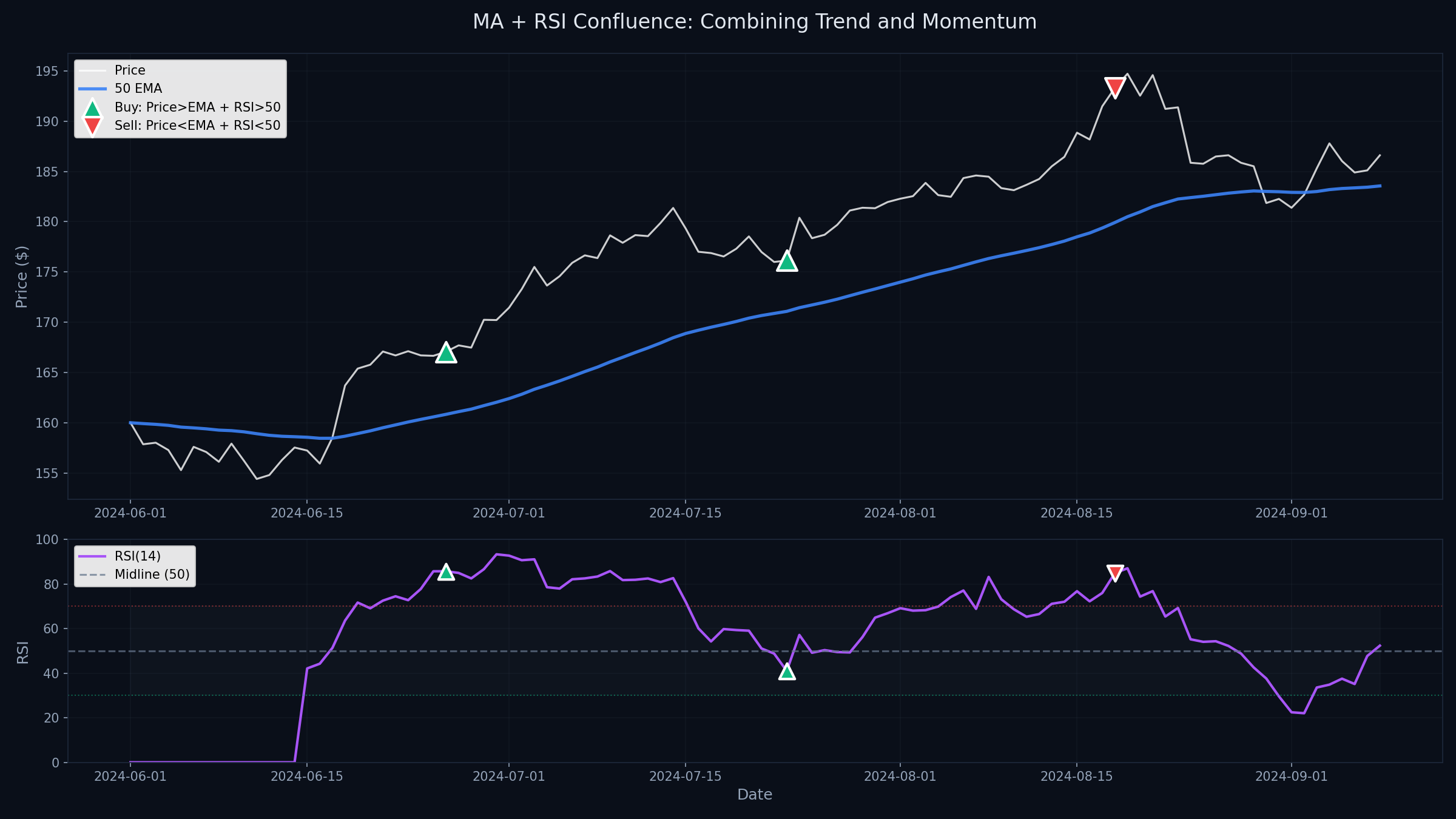
The most powerful MA strategies combine trend (MA) with momentum (RSI, MACD) or volume confirmation. This creates confluence – multiple signals agreeing simultaneously.
MA + RSI Confluence System
This system filters MA signals using RSI momentum, dramatically improving win rates.
50 EMA + RSI(14) Strategy:
Long Entry Requirements (ALL must be true):
- Price is above 50 EMA (trend confirmation)
- RSI crosses above 50 (momentum confirmation)
- Price pulls back to 50 EMA but holds above it
- Volume on bounce > 20-day average
Short Entry Requirements:
- Price is below 50 EMA
- RSI crosses below 50
- Price rallies to 50 EMA but fails below it
- Volume on rejection > 20-day average
Risk Management:
- • Stop Loss: 3 ATR from entry
- • Take Profit: 2:1 or 3:1 risk-reward
- • Position Size: Risk 1% of capital per trade
📈 Real Example: TSLA MA+RSI Confluence
Date: November 2024
Setup: TSLA pulled back to 50 EMA at $242 after strong rally
- • Trend: Price above 50 EMA (uptrend) ✓
- • Momentum: RSI bounced from 48 to 54 (bullish) ✓
- • Support: Price held above 50 EMA ✓
- • Volume: Bounce day volume 15% above average ✓
Trade Execution:
- • Entry: $243.50 (next day open)
- • Stop Loss: $236.00 (below EMA + ATR buffer)
- • Target: $266.00 (3:1 R:R)
- • Result: Hit target in 8 days, +9.2% gain
MA + MACD Combination
MACD (Moving Average Convergence Divergence) is itself based on MAs, making it a natural complement to price-based MA strategies.
- Trend Filter: Only take MACD signals when price is on correct side of 200 SMA
- Entry Timing: MACD crossover + price above/below 50 EMA
- Exit Signal: MACD histogram turns negative (for longs) or positive (for shorts)
✅ Confluence Checklist for High-Probability Trades
- Trend: Price position relative to 50/200 MA
- Momentum: RSI direction and level
- Volume: Above or below average on key moves
- Support/Resistance: MA acting as dynamic S/R
- Multiple Timeframes: Higher TF confirms direction
Rule: Need at least 3 of 5 factors aligned for entry.
Advanced Filtering Techniques
Even the best MA strategies generate false signals. Advanced filters help you avoid low-probability trades.
ADX Trend Strength Filter
The Average Directional Index (ADX) measures trend strength without indicating direction.
- ADX > 25: Strong trend – use trend-following MA strategies
- ADX < 20: Weak/no trend – use mean reversion or avoid trading
- ADX 20-25: Transitional – wait for clarity
ADX-Filtered MA Crossover:
Rules:
- • Use 50/200 MA crossover as base signal
- • Only enter if ADX > 25 (confirms trend strength)
- • If ADX < 20 at crossover, skip the trade
- • Exit when ADX drops below 20 (trend weakening)
Backtest Results (S&P 500, 2015-2024):
- • Without ADX filter: 58% win rate, 12 trades/year
- • With ADX > 25 filter: 74% win rate, 7 trades/year
- • Improvement: +16% win rate, fewer but better trades
Higher Timeframe Confirmation
Always check the next higher timeframe before entering a trade based on MA signals.
- Trading 1H chart? Check 4H and daily MAs
- Trading daily? Check weekly and monthly MAs
- Rule: Only trade in direction of higher timeframe MA trend
Volume Confirmation
MA signals are more reliable when accompanied by volume confirmation:
- Bullish MA cross: Volume should be above 20-day average
- Bearish MA cross: Volume should increase on breakdown
- MA bounce: Volume should surge on the bounce day
- Low volume signals: Often fail or produce weak moves
Putting It All Together
Here's a complete advanced MA trading system that combines multiple techniques:
Professional Multi-Factor MA System:
Indicators:
- • KAMA(10,2,30) – adaptive trend
- • 50 EMA – intermediate trend
- • 200 SMA – long-term trend
- • RSI(14) – momentum
- • ADX(14) – trend strength
- • Volume MA(20) – volume confirmation
Long Entry Criteria (ALL required):
- Price > 200 SMA (bull market)
- Price pulls back to 50 EMA and holds
- KAMA turns up from 50 EMA touch
- RSI > 50 and rising
- ADX > 25 (strong trend)
- Volume on bounce > 20-day average
Position Sizing:
- • Risk 1% of capital per trade
- • Stop loss: 2 ATR below entry
- • Position size = (Account × 0.01) / (Entry - Stop)
Exit Strategy:
- • Profit target: 3:1 risk-reward ratio
- • Trailing stop: Move stop to breakeven at 1:1, then trail below KAMA
- • Time stop: Exit if no progress after 10 days
- • Emergency exit: Close below 50 EMA with RSI < 45
💡 System Performance Expectations
- • Win Rate: 60-70% (high due to multiple filters)
- • Trade Frequency: 2-4 trades per month per symbol
- • Average R:R: 2.5:1 (winners bigger than losers)
- • Best Markets: Trending stocks, major indices, liquid ETFs
- • Avoid: Low-volume stocks, extreme volatility, news-driven moves
Common Mistakes to Avoid
🚨 Advanced MA Trading Pitfalls
- • Over-optimization: Don't curve-fit parameters to past data. Use standard settings (50, 200) or simple adaptations
- • Too many filters: More filters = fewer trades. Balance quality vs. quantity
- • Ignoring market regime: Adaptive MAs work in volatility, envelopes work in ranges, crossovers work in trends
- • No position sizing: Advanced techniques mean nothing without proper risk management
- • Forgetting lag: Even adaptive MAs lag. Never expect perfect entries
Key Takeaways
- Adaptive MAs (KAMA, VIDYA) adjust to market conditions, reducing whipsaws in choppy markets while staying responsive in trends
- Displaced MAs create buffer zones that filter out noise and provide clearer support/resistance levels
- MA envelopes work best for mean reversion in range-bound markets; avoid during strong trends
- Confluence trading (MA + RSI + Volume) dramatically improves win rates by requiring multiple confirmations
- Filters (ADX, higher timeframes) help you avoid low-probability trades and focus on high-quality setups
- Complete systems combine multiple techniques with strict risk management for consistent results
✅ Next Steps
- Choose ONE advanced technique to master first (start with displaced MAs or MA+RSI)
- Backtest on your favorite stocks/timeframes for at least 100 trades
- Paper trade for 1-2 months before risking real capital
- Keep a detailed trade journal tracking which filters work best
- Gradually add complexity only if it improves results
This completes our comprehensive moving average series. You now have the tools to build professional-grade MA trading systems. Remember: simplicity often beats complexity. Master the basics before adding advanced techniques.
Ready to Put This Into Practice?
Join MarketDly to access real-time market insights, AI-powered analysis, and professional trading tools.
No credit card required • Free tier available • Upgrade anytime